
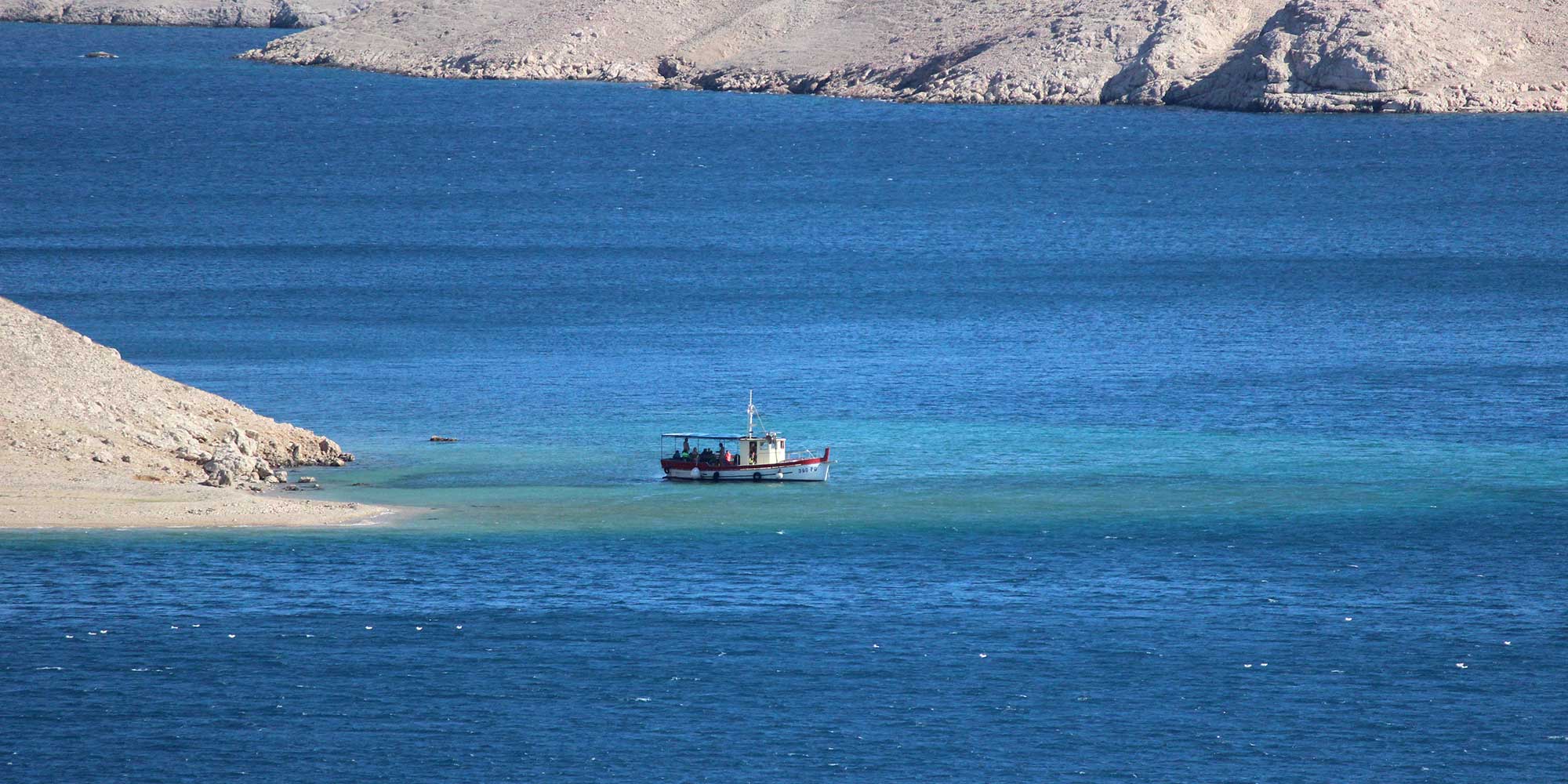
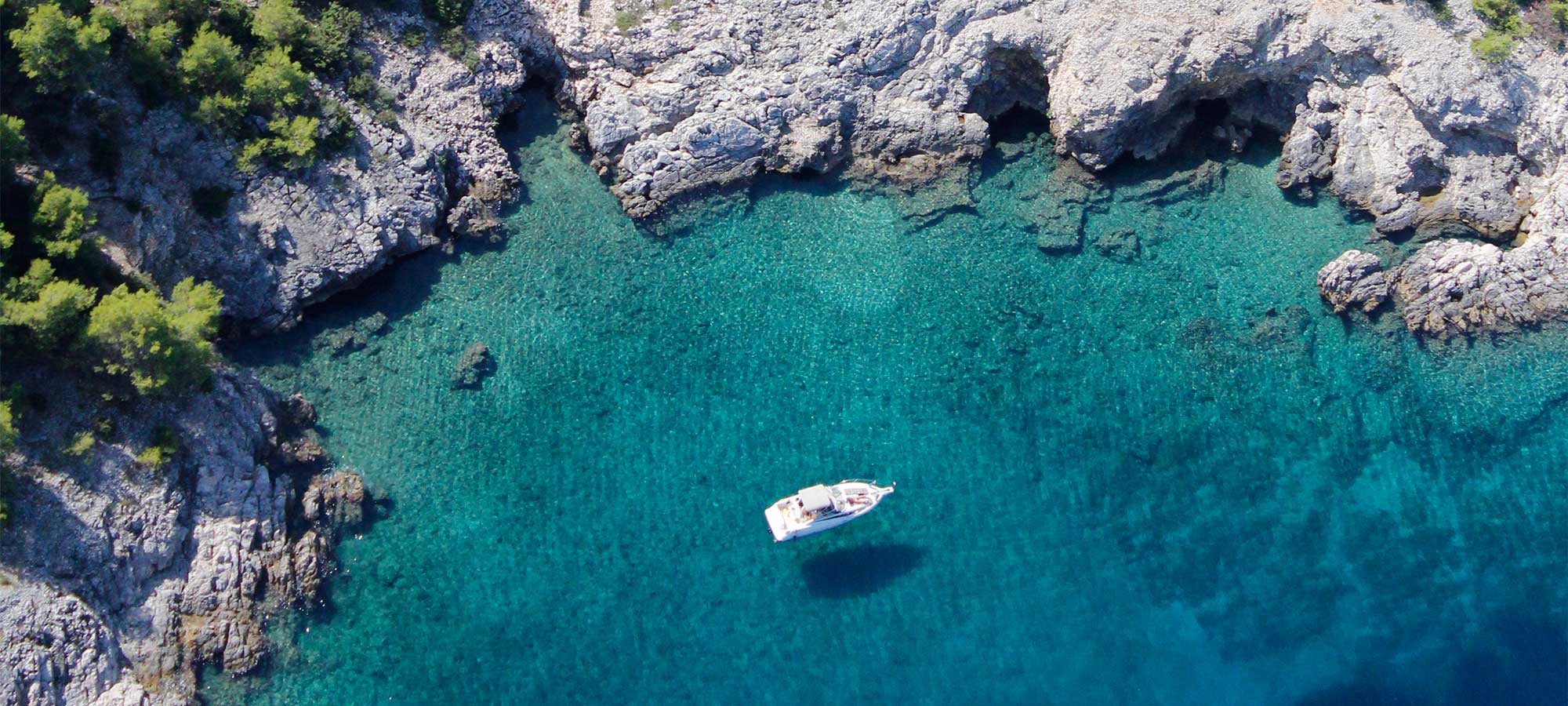
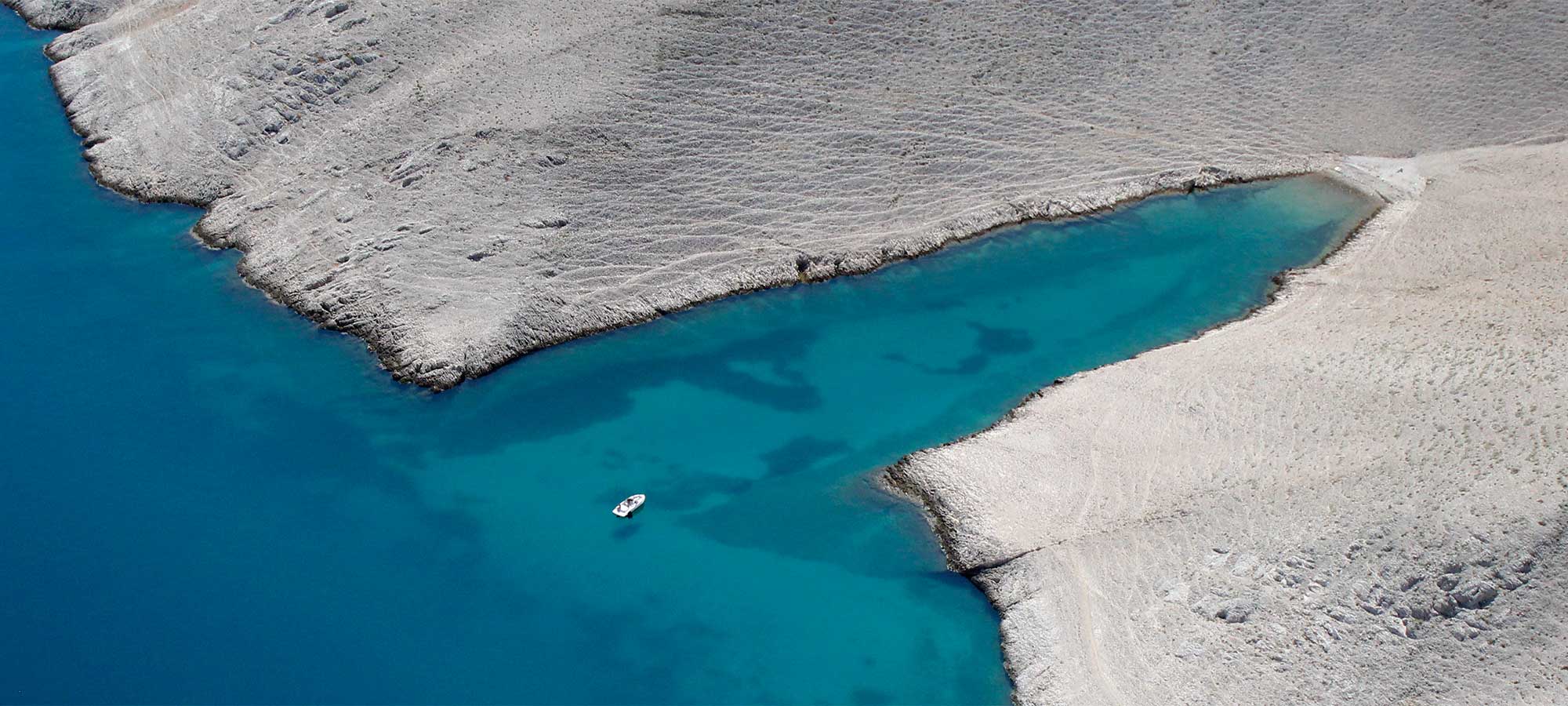


Welcome to Metajna
Where the Island Breathes
A hidden gem on the Island of Pag. Crystal-clear Adriatic waters, timeless stone, and the kind of quiet that's getting harder to find.
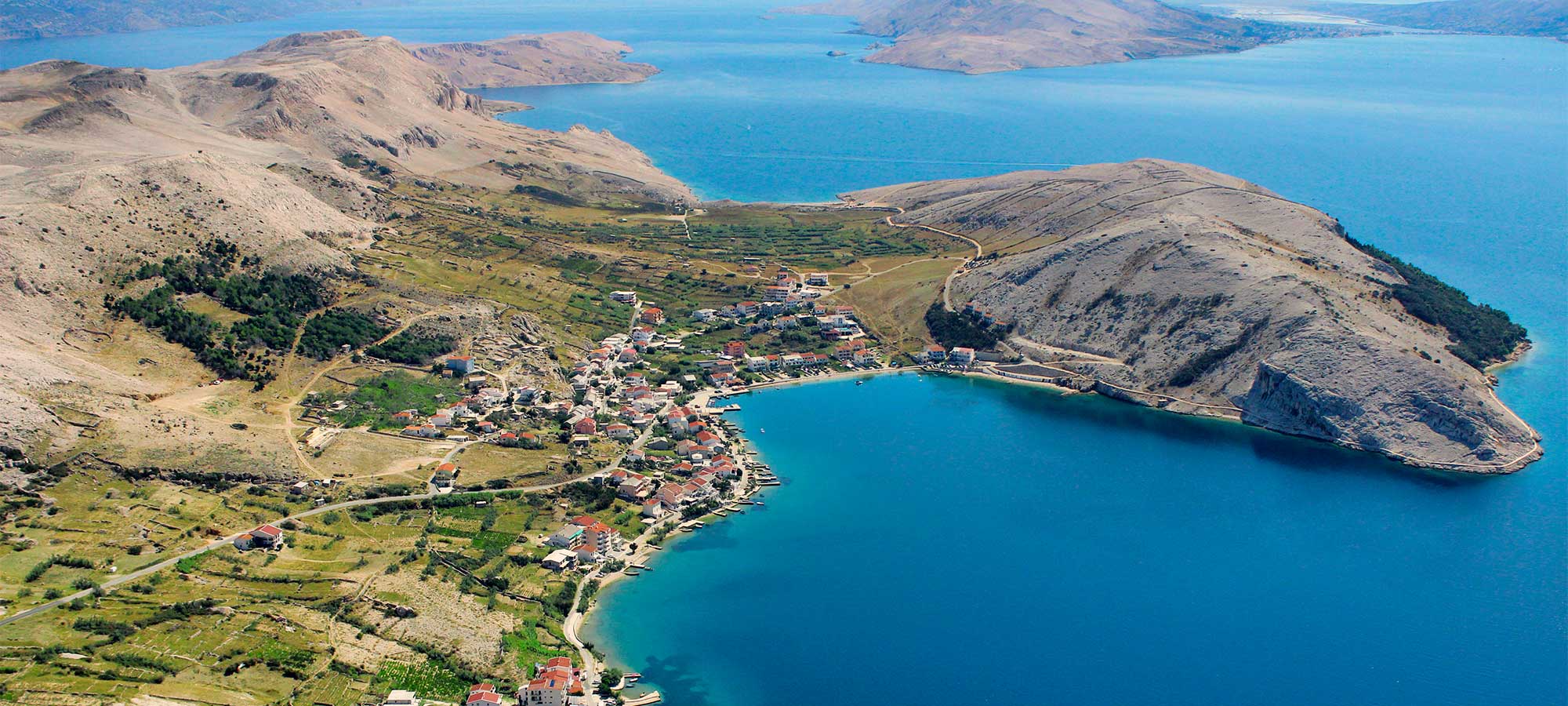
Metajna sits tucked into a sheltered bay on Pag's northeastern coast — small, unhurried, and utterly unspoiled. No crowds. No noise.
Just the sea, the stone, and the sun.

Accommodation in Metajna – apartments & rooms
Beaches in Metajna, Island of Pag, Croatia
Metajna is not just another beach destination. The beaches with names, with paths, with parking are only the beginning. The real number is far greater,
and thanks to the Life on Mars Trail, more of them are now within reach than ever before. Hidden coves once accessible only by boat are now opening up to hikers and
explorers willing to venture off the beaten path. In Metajna, every walk along the coast leads somewhere new.
Start at Ručica Beach, the most beloved cove on Pag island — a spectacular sandy-pebble bay with turquoise water, gentle slopes,
and free parking right at the shore. From there, the coast opens up into wilder territory. Beritnica Beach draws adventurers and
snorkelers with its dramatic natural rock arch and exceptional water clarity. Metajna Beach sits at the heart of the village —
calm, gentle, and wonderfully unhurried. Further along, Slano Beach hides beneath towering cliffs in near-total seclusion,
its crystal water a reward for those who find it. Seline Beach stretches across a long sweep of fine pebbles backed by dramatic cliffsides —
a hidden treasure hiding in plain sight. For those willing to venture a little further, Malin Beach waits at the end of a scenic coastal walk
or a short boat ride — more remote, more raw, and all the more rewarding for it. And as the day draws to a close, there is nowhere better to be
than Zaglava Beach, a clifftop gem with deep blue water and the best sunset views on the entire coast. Countless beaches.
Each one waiting to be discovered.
Life on Mars Trail – hiking on Pag island
If you're searching for unique hiking experiences in Croatia, nothing comes close to the Life on Mars Trail on the Island of Pag. Named for a landscape so alien, so strikingly barren, that it genuinely resembles the surface of Mars — or the Moon — this trail has become one of the most talked-about outdoor attractions in the entire Adriatic region. Multiple difficulty levels make it accessible to everyone, from casual walkers to seasoned trail runners. The Challenge route stretches 24 km through some of the most dramatic terrain in Croatia. Every year, on the last weekend of March, the Life on Mars Trail Race draws competitors and spectators from across the region in a growing event that puts Metajna firmly on the map for adventure tourism in Croatia. There is nothing like this anywhere else in the Mediterranean.
Everything You Need. Nothing You Don't.
Quality accommodation, good food, and local shops — all at prices that will surprise you. Metajna delivers a genuine island experience without the resort price tag. Come to slow down. Stay because you can't leave.
Crystal Sea
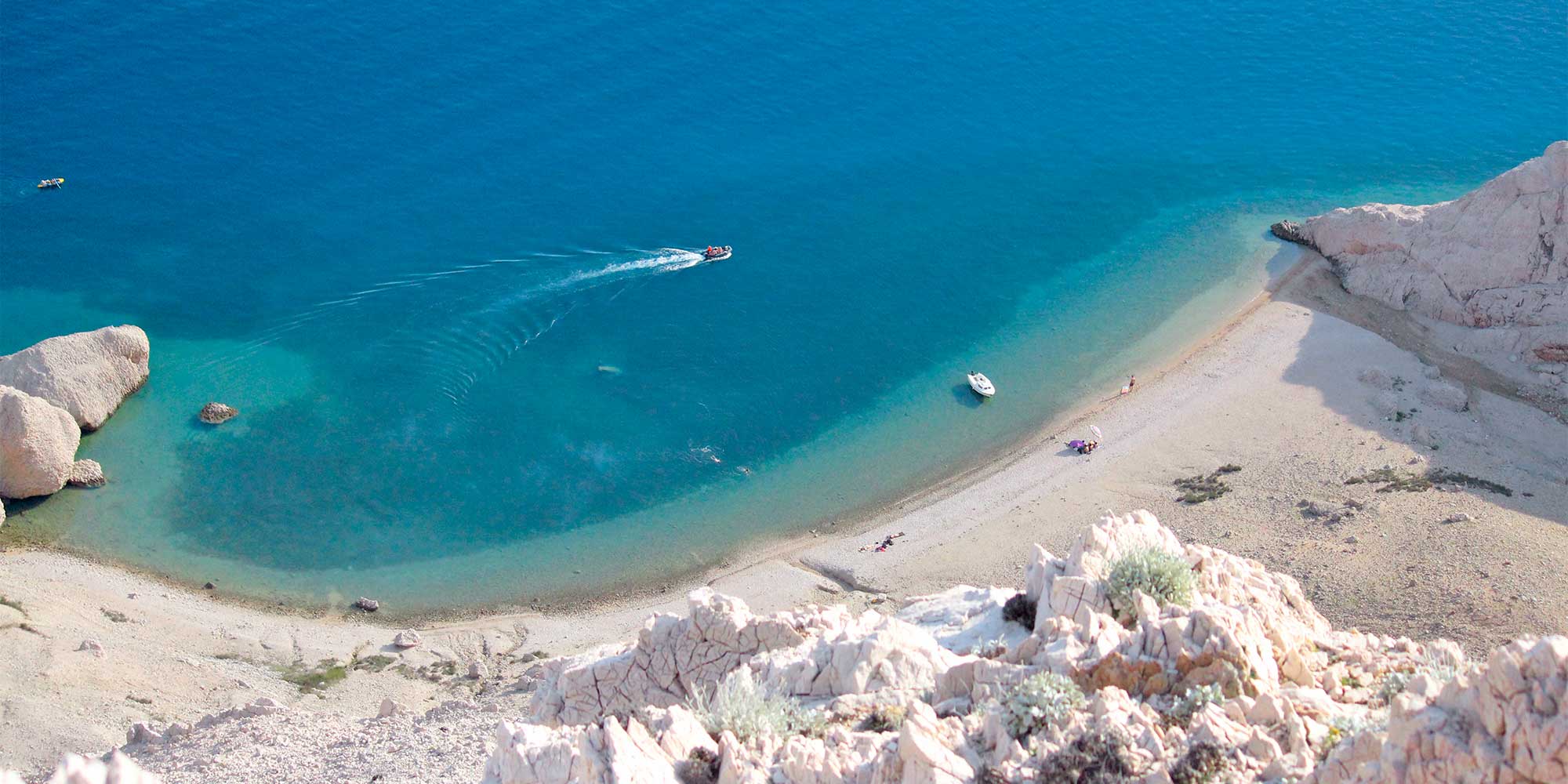
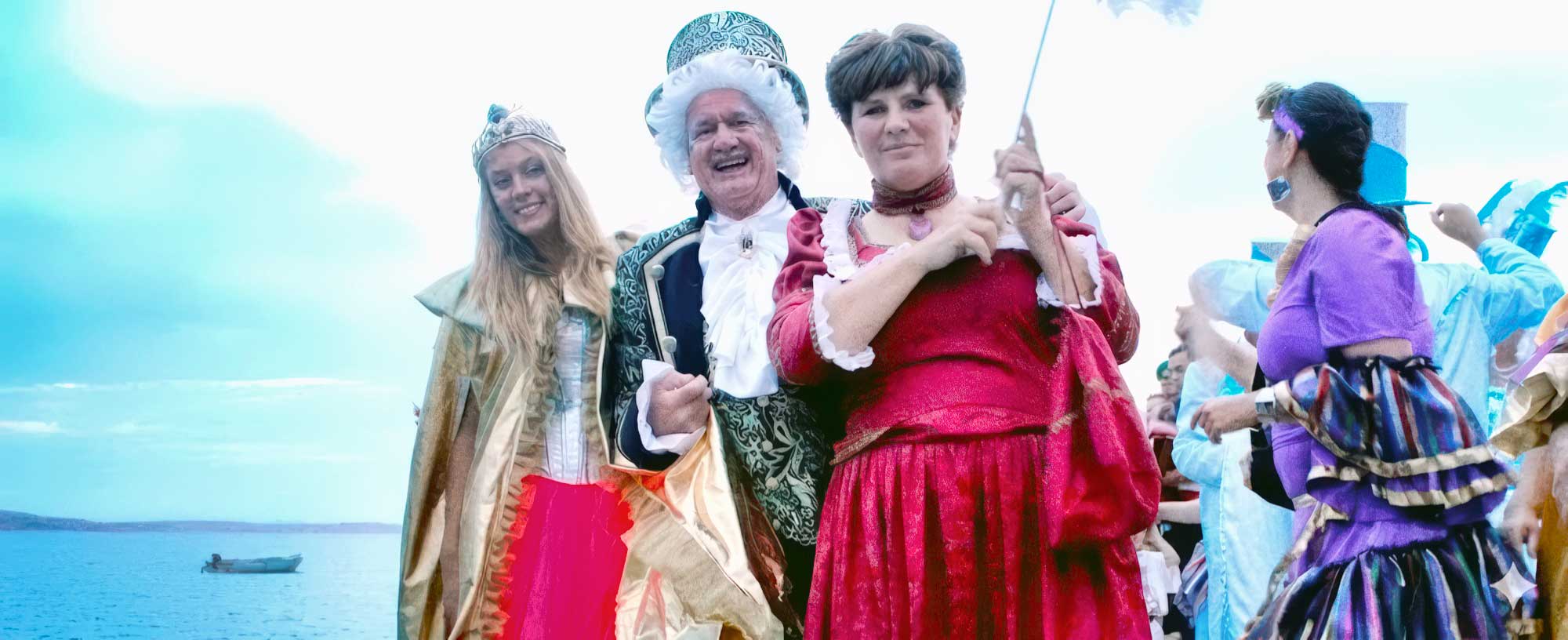
When people ask where to find the clearest water in the Adriatic, the answer keeps coming back to the same place: Metajna, on the Island of Pag, Croatia. With underwater visibility reaching up to 30 meters, the sea here belongs to a different category entirely. Snorkeling in Metajna means drifting over pristine seabeds in water so transparent it barely seems real. Swimming here means feeling the kind of clean, cool, turquoise embrace that most Adriatic visitors only dream about. Whether you're looking for the best snorkeling in Croatia, a safe and shallow spot for families, or simply the most beautiful water you've ever swum in — Metajna delivers, every single time.
Hospitality
Looking for affordable accommodation on the Island of Pag without sacrificing quality? Metajna is where you find it. This small, welcoming village on Pag's northeastern coast offers a range of accommodation options — from charming family-run apartments to spacious holiday rentals — all delivering the kind of personal, warm hospitality that only a genuine community can offer. Local restaurants serve fresh Adriatic seafood and traditional Pag cuisine. Shops and services cover everything a visitor needs for a comfortable, relaxed stay. And through it all, Metajna remains one of the most affordable holiday destinations on the Croatian coast — a place where the quality is high, the prices are honest, and the welcome is real. For families, couples, hikers, and beach lovers looking for the best value holiday in Croatia, Metajna is simply hard to beat. Ready to plan your stay? Send a booking enquiry directly through our Metajna contact form and we'll get back to you personally. Your Adriatic escape is closer than you think.
Untouched Nature
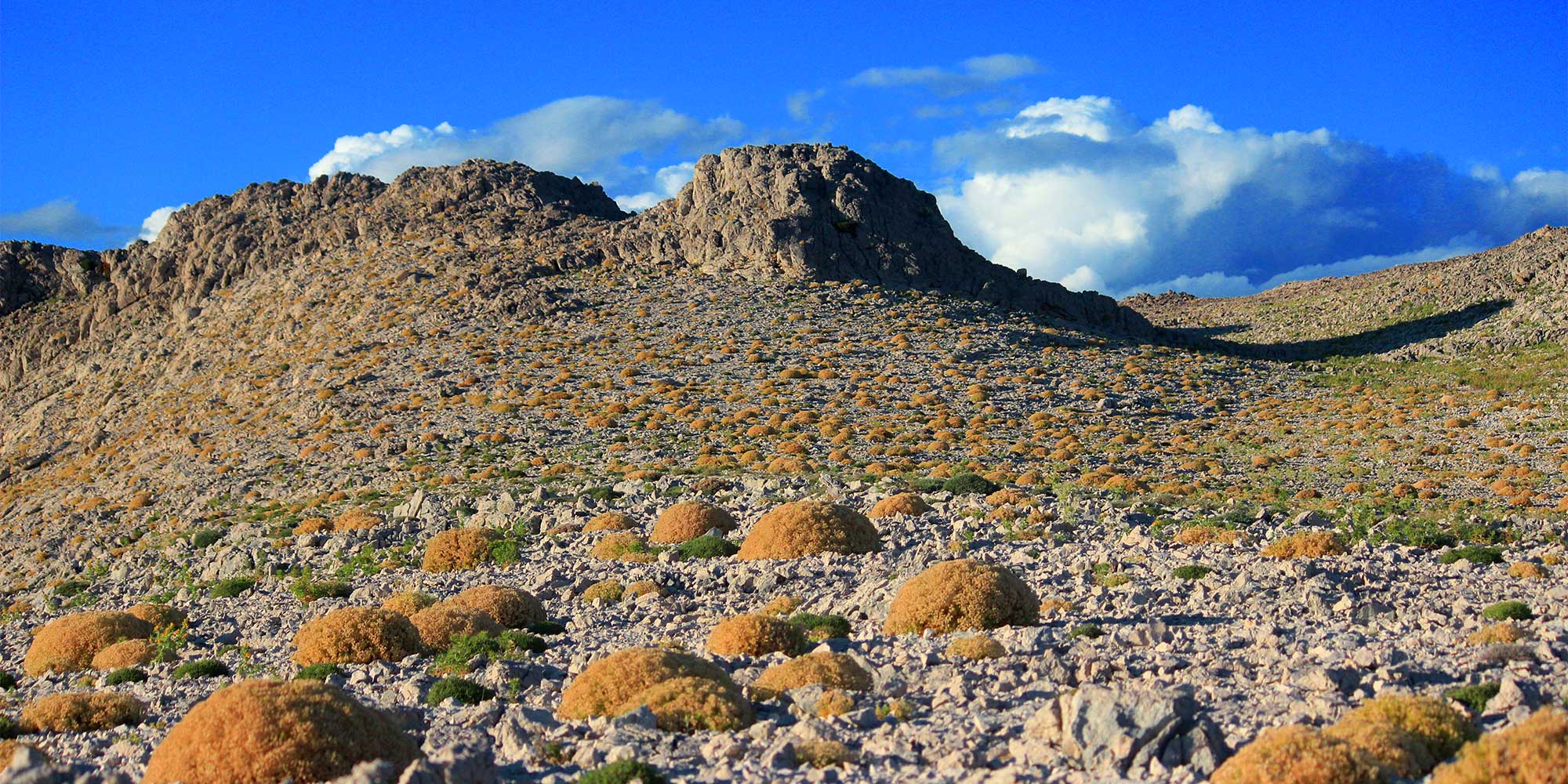
For travellers seeking unspoiled nature in Croatia, the landscape around Metajna, Pag island, is in a category of its own. This is not a manicured nature park or a curated eco-trail. This is raw, ancient, elemental Adriatic wilderness — lunar karst terrain sculpted by centuries of wind and salt, stretching wide under an open Croatian sky. The air is thick with the fragrance of sage, immortelle, and wild herbs that grow undisturbed across the island. Birdwatchers, photographers, botanists, and anyone who values genuine natural beauty will find something extraordinary here. In an era when truly untouched coastline in Europe is increasingly rare, Metajna stands apart as one of the last places where nature still sets the terms.
Beaches of Metajna
Ručica Beach — Pag Island's Most Beloved Cove
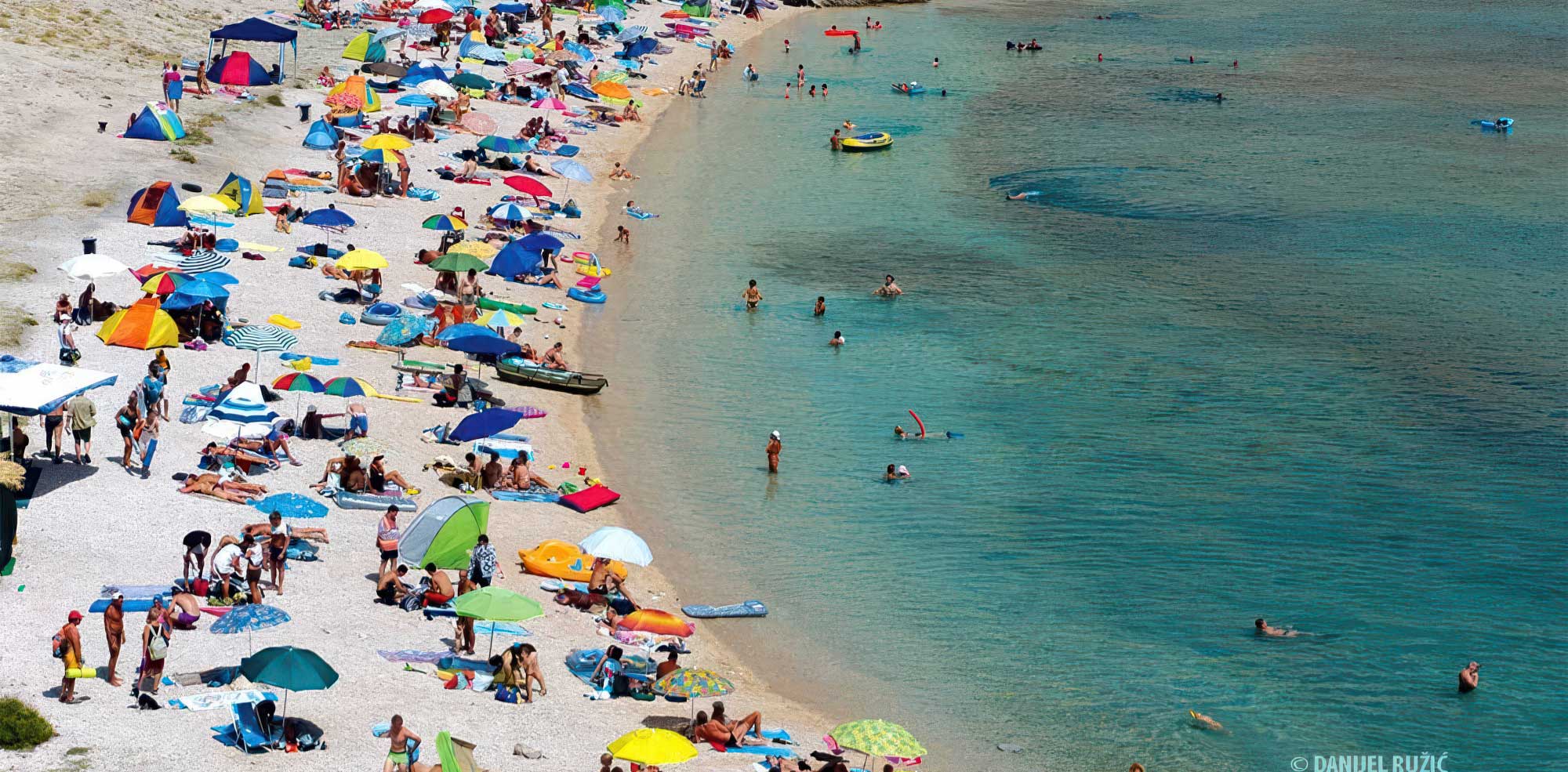
Consistently ranked among the most beautiful beaches in Croatia, Ručica Beach near Metajna on the Island of Pag is the kind of place
that stays with you long after you've left. Stretching 220 meters of smooth pebbles, the beach sits at the foot of a dramatic karst landscape
that visitors consistently describe as Martian — raw, otherworldly, and completely unlike anything else on the Adriatic coast.
The water is the star. Exceptionally clear, calm, and turquoise, with a gentle slope that makes it ideal for families, children,
and anyone who simply wants to swim without worrying about currents or depth. Rated number one among things to do in Metajna on Tripadvisor,
Ručica earns its reputation every single season.
Accessible by car via a scenic road with panoramic Adriatic views — with a large free parking lot right at the entrance,
one of the rare beaches on the Croatian coast where parking won't cost you a thing. A seasonal beach bar and restaurant complete the picture,
offering refreshments without turning the place into a resort.
Outside of peak season, Ručica transforms into something else entirely — a film set.
The extraordinary contrast of turquoise water against white karst rock has made it one of the most sought-after filming locations on the Adriatic.
Music videos, fashion editorials, and commercials for world-renowned brands including Vogue have all been shot here.
Croatian artists Severina and Ana Rucner chose Ručica as the backdrop for their music videos — and once you see it, it's easy to understand why.
And when you're ready to explore further, Ručica is the perfect starting point. A marked trail leads directly to Beritnica Beach and beyond —
the gateway to the wild, untouched coastline that makes this corner of Pag island truly exceptional.
Beritnica Beach — Pag Island's Most Spectacular Hidden Cove
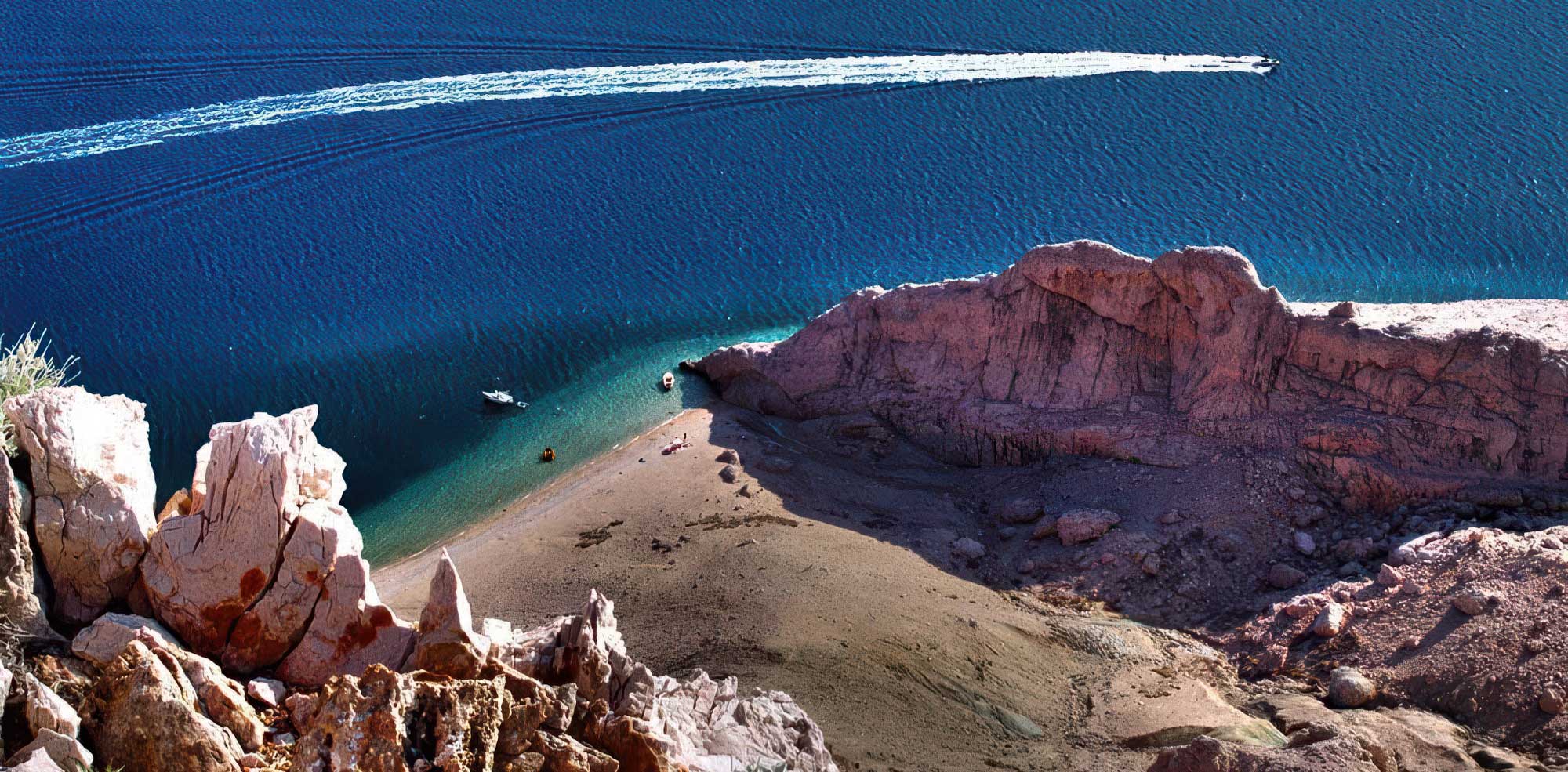
Ranked number one among all 91 beaches of Lika-Senj County, Beritnica Beach near Metajna
is not just a beach — it is an experience that stops people in their tracks. Tucked into a wild, untouched cove on the Island of Pag,
surrounded by bare karst cliffs and the kind of silence that feels earned, Beritnica rewards those willing to make the journey in a way few beaches in Croatia
can match.
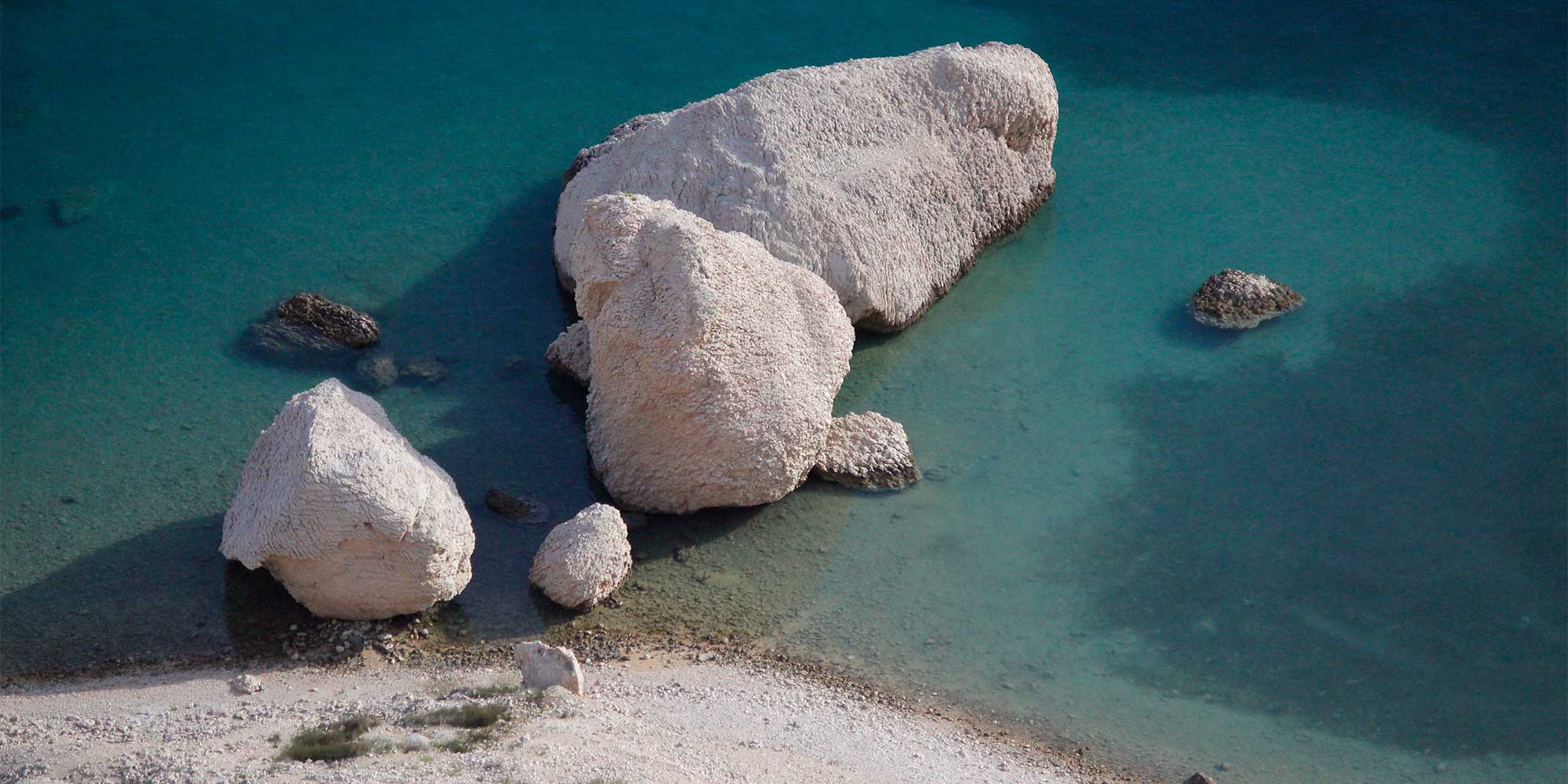
Nature itself has arranged three large rocks directly into the shallow sea here — a natural installation so striking it seems almost deliberate.
Above the beach, the famous climbing cliff Stogaj rises — one of the most spectacular stone towers on the entire Adriatic coast.
The landscape is raw, ancient, and completely devoid of the commercial trappings that define so many Croatian beaches. No sunbed rentals. No entrance fees.
Just rock, water, and sky.
Beritnica is reachable on foot via a scenic 20-minute trail from Ručica Beach, passing through a dramatic canyon of karst rock with views that open up at every turn.
It can also be reached by taxi boat — an 8-minute ride from Ručica for those who prefer to arrive from the sea.
Either way, the approach only adds to the sense of discovery.
And for those with a curious mind, the rocks around Beritnica hold more than beauty — fossils have been found in the surrounding area,
including remains of ancient crocodile teeth, carbonated wood from the Miocene period, and even evidence of Sequoia trees that once grew around an ancient lake here,
millions of years ago. One of the most photographed and least understood beaches on the Adriatic — Beritnica is, simply put, unlike anywhere else.
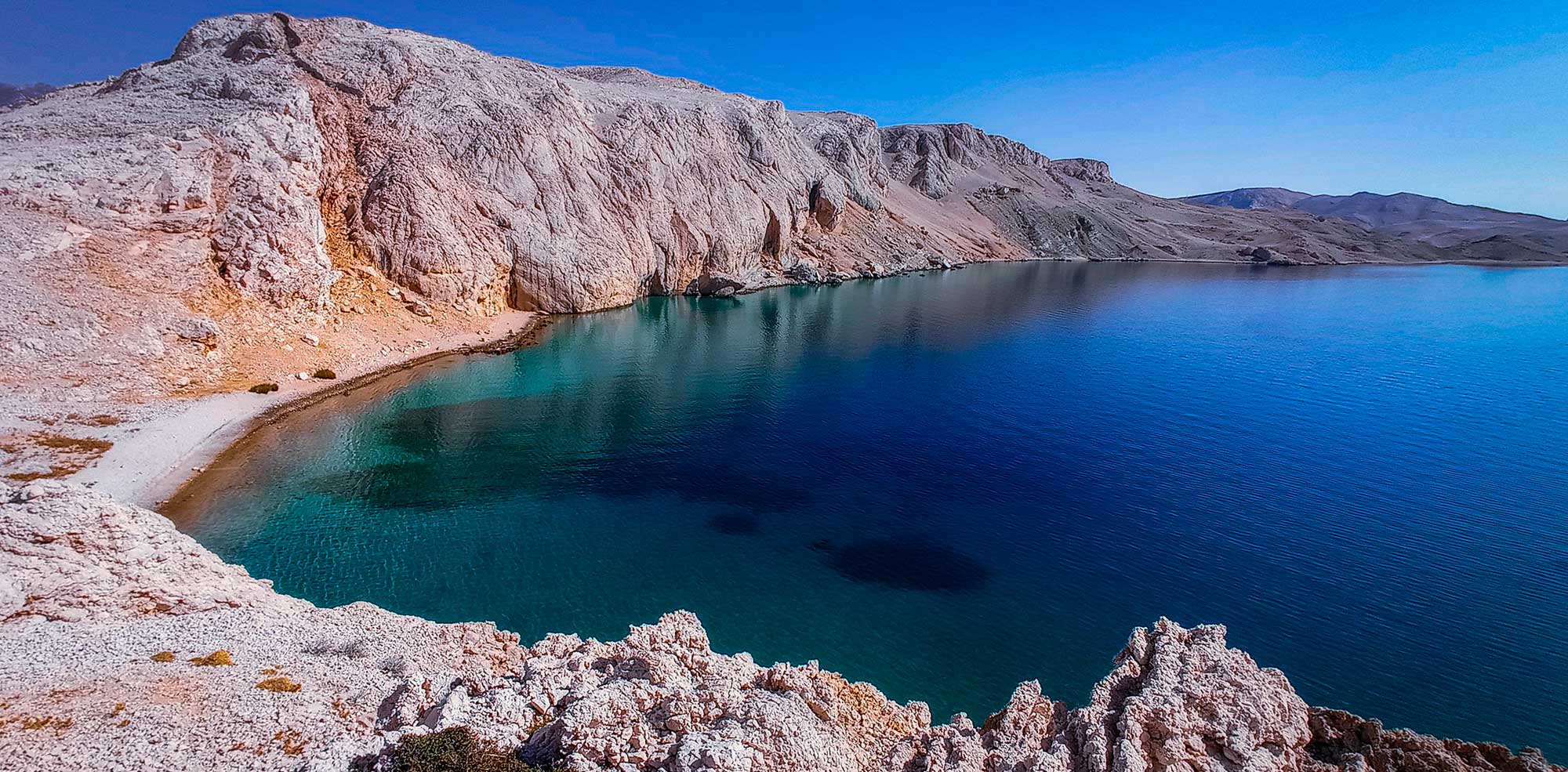
Slano Beach — Pag Island's Most Secluded Retreat
Slano Beach is not a beach you stumble upon. Tucked into a quiet cove on the eastern coast of Pag Bay,
surrounded by dramatic rocky cliffs and reddish karst stone, it belongs to that rare category of places that feel genuinely undiscovered —
even in the height of summer. No facilities, no crowds, no noise. Just fine gravel, crystal-clear turquoise water,
and the kind of silence that reminds you why you left the city.
The beach sits near the Pag Gate, a narrow passage connecting Pag Bay with the Velebit Channel, with views of the peninsula stretching north from the town of Pag
that can only be described as enchanting. The rocky cliffs surrounding the cove create an atmosphere of complete, exclusive intimacy —
a natural amphitheatre open only to the sea, with the Rushmore of the Adriatic rising along the coast just beyond,
toward Cape Sušac.
For those following the Life on Mars Trail, Slano is an unmissable stop — a hundred-metre ferrata stretches directly from the beach,
adding a layer of adventure to an already extraordinary setting. Reachable by boat or on foot via a well-marked hiking trail from Metajna,
the journey to Slano is part of the experience. The local sheep, drawn to a freshwater spring located just above the beach, are frequent and photogenic visitors —
a reminder that this corner of Pag operates entirely on its own terms.
For those seeking the most unspoiled beach experience on the Island of Pag, Slano is the answer.
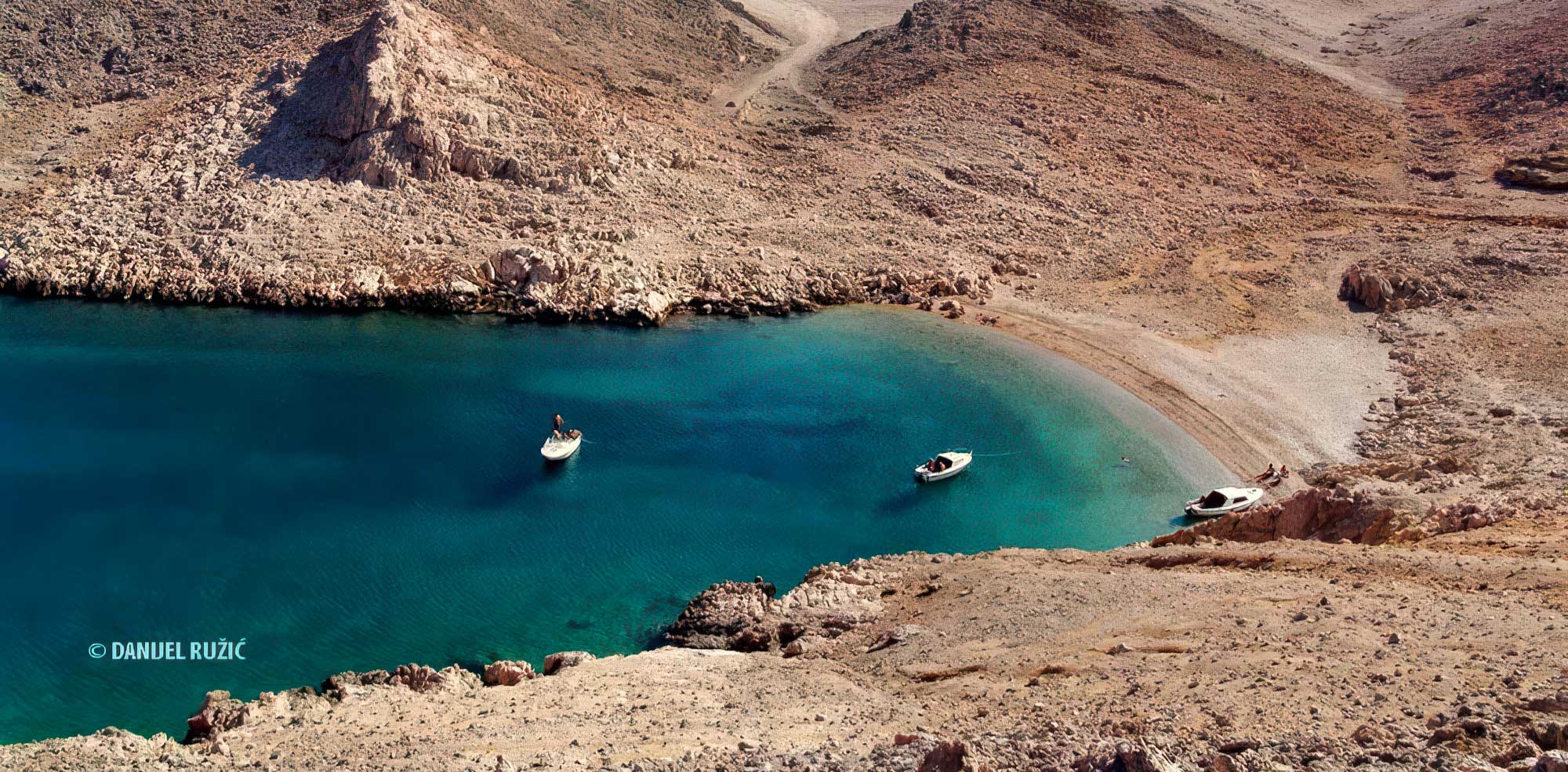
Seline Beach — Pag Island's Most Magical Hidden Bay
Seline Beach is the kind of place that rewards patience. Deeply incised into the rocky coastline facing the Velebit Channel,
this long stretch of fine pebbles and sand sits framed by dramatic cliffs on all sides — a natural amphitheatre that offers a sense of secrecy and
tranquillity that is increasingly rare on the Adriatic coast. The bay cuts so deeply into the karst landscape that the outside world simply disappears.
The views from Seline are among the most spectacular on the island. Directly across the Velebit Channel, the towering peaks of the Velebit mountain
range fill the entire horizon — a backdrop so cinematic it barely seems real. At sunrise and sunset, the light here transforms the entire scene into something extraordinary,
which is why Seline has earned a reputation as one of the most beautiful viewpoints on Pag island, not just one of its finest beaches.
Natural freshwater springs feed cool water into the turquoise sea even in the hottest months — a rare and welcome feature that keeps the water refreshing
when the August sun is at its peak. Fine pebbles and sand make entry into the sea effortless, and the beach never reaches the crowds
found on more accessible stretches of the coast. No facilities, no sunbeds, no noise — just the sea, the cliffs, and the Velebit beyond.
Reachable by boat or on foot via the Life on Mars Trail, Seline Beach sits near the end of a route that already delivers extraordinary scenery
at every turn. Those who make the journey consistently rate it among the most beautiful hidden beaches in Croatia — and once you arrive, it is easy to understand why.
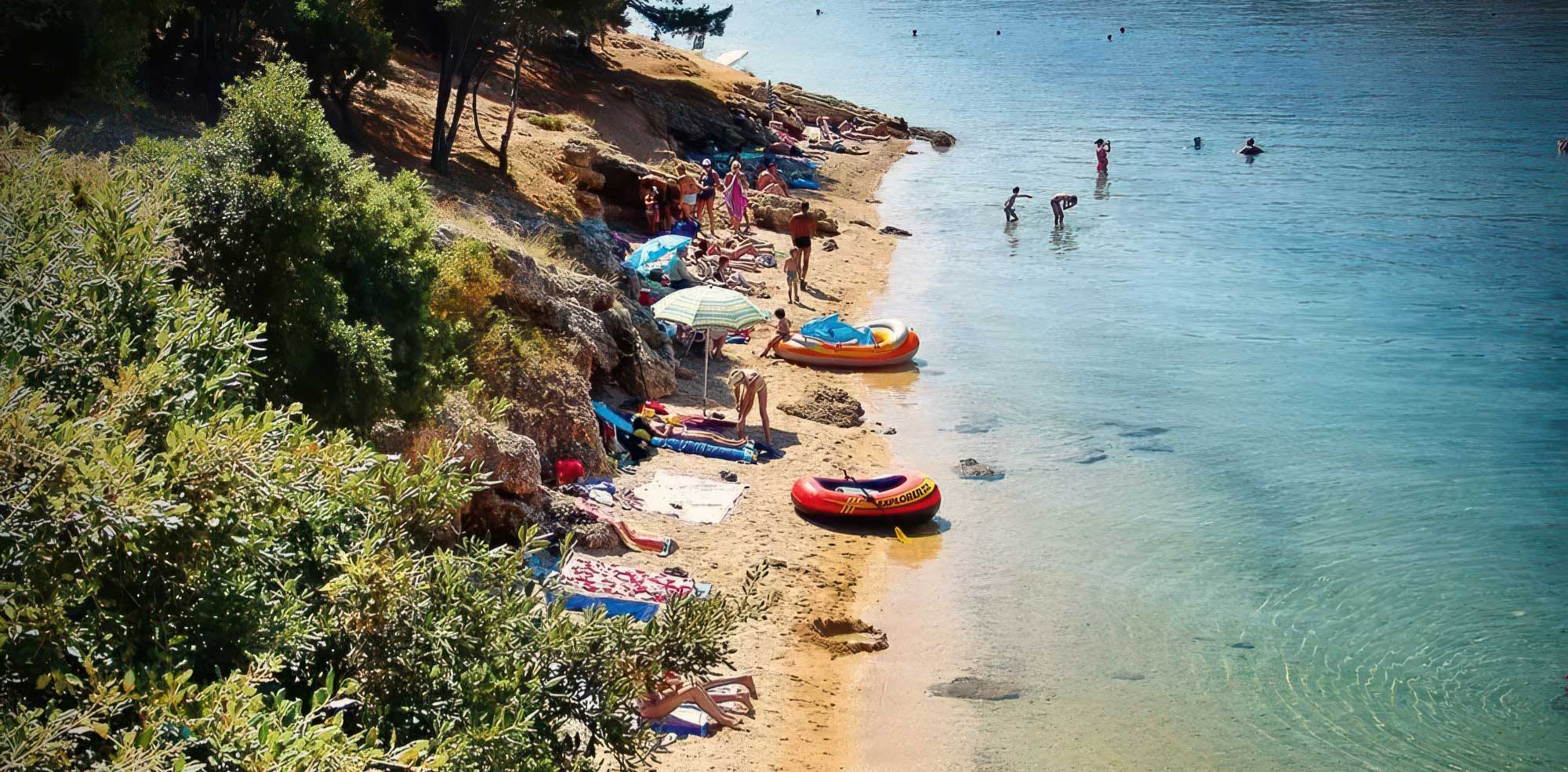
Zaglava Beach — Pag Island's Ultimate Sunset Spot
There is a moment at Zaglava Beach when the sun begins to drop toward the horizon and the entire Adriatic turns gold — and in that moment,
it becomes clear why this cliffside beach near Metajna has become one of the most celebrated sunset points on the Island of Pag. Deep, clear water.
Dramatic cliff faces. And a view that stretches across the open sea without a single obstruction.
Unlike the exposed karst beaches further along the coast, Zaglava offers a rare and welcome contrast — a canopy of pine trees overhanging the shore,
providing natural shade during the heat of the day and a fragrant, resinous coolness that makes the beach feel like a world apart.
A small navigation lighthouse marks the entrance to the cove, and a stone pier steps directly into the turquoise sea — making entry into the water effortless and
the whole setting feel like something from another era. Several small coves divide the beach into pockets of privacy, each one offering its own sense of seclusion and calm.
The water here is deep and exceptionally clear — a favourite among swimmers, snorkelers, and free divers who come for the visibility and stay for the atmosphere.
Arrive in the afternoon. Stay for the sunset. Leave when you're ready — which might be later than you planned.
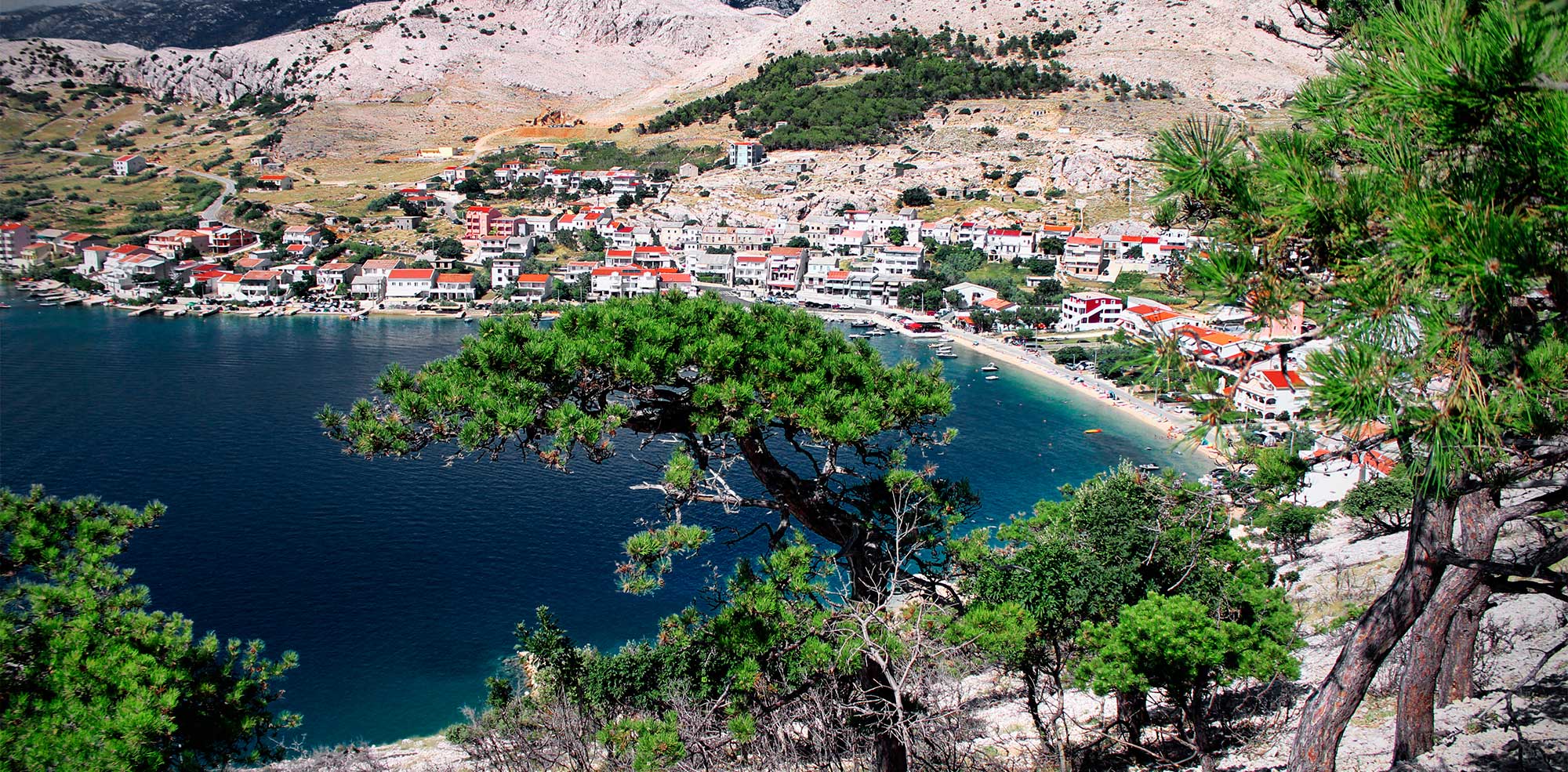
Metajna Beach — The Heart of the Village
Some beaches demand an expedition. Metajna Beach is not one of them — and that is precisely its charm.
Stretching along the village waterfront in a sheltered, south-facing bay, this gentle pebble beach sits steps away from apartments, restaurants, cafés,
and the small harbour where fishing boats bob quietly in the morning sun. Everything you need is within easy reach. The sea is right there.
The water in Metajna Bay is calm, clear, and shallow at the shoreline — ideal for families with young children, for early morning swimmers,
and for anyone who simply wants to be in the sea without making a plan. The gradual depth and absence of waves make it one of the safest and
most relaxed bathing spots on the Island of Pag, while the teal-blue colour of the bay, visible even from the cliffs above the village, speaks for itself.
In the evenings, the beach transforms naturally into a promenade — a place to walk, to sit, to watch the light change over the water while the village comes alive
around you. For those staying in Metajna, this is the beach that bookends the day: a morning swim before breakfast, an evening dip before dinner.
Not the most dramatic beach on the coast. Just the most convenient, the most welcoming, and the one you'll use every single day.
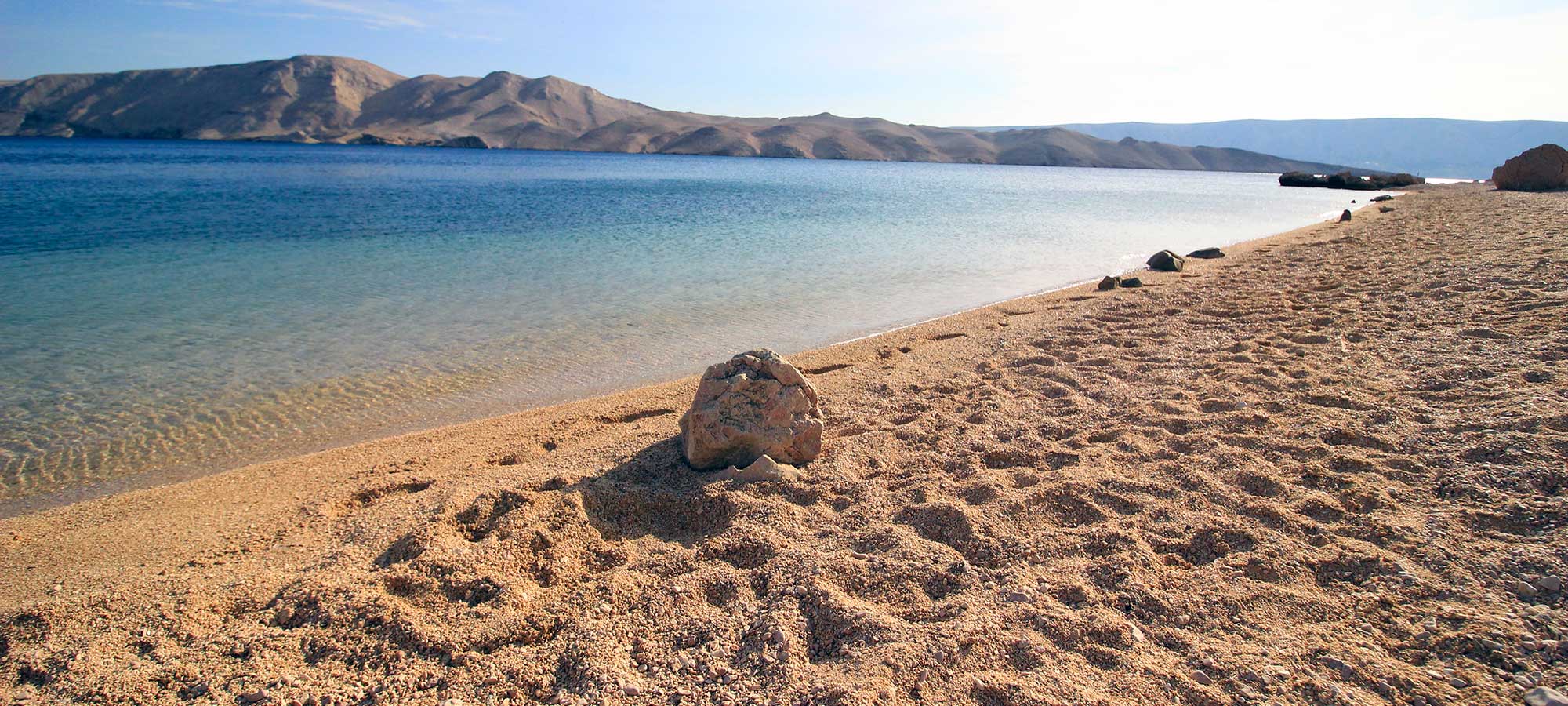
Malin Beach — Pag Island's Best Kept Secret
Malin Beach sits at the entrance to Pag Bay — the Paška Vrata, the Gate of Pag — where the open sea narrows between the island and
the mainland, and the water turns a shade of turquoise that stops people mid-stroke. This is not a beach that announces itself. It has no facilities,
no signage, no crowds. What it has is fine golden sand, crystal-clear shallow water, and a panoramic view across Pag Bay toward the bare,
ochre-coloured hills behind which the ancient town of Pag quietly sits — a landscape so stripped and elemental it looks like the edge of the world.
Ranked first among all 300 beaches of the Zadar region — a remarkable distinction for a beach that most visitors to Croatia have never heard of.
That paradox is exactly what makes Malin special. While the crowds head to the well-known spots further up the coast, Malin sits quietly at the entrance to Pag Bay,
doing what it has always done: being extraordinary without making any effort at all.
A natural freshwater spring sits just beside the beach — a rare and ancient feature that has served sailors and travellers navigating the Paška Vrata passage for centuries.
The water is cool, clean, and free — a reminder that this stretch of coastline has been sustaining life long before tourism arrived.
Reachable by boat or on foot via the Life on Mars Trail, Malin Beach rewards those who make the journey with one of the most unspoiled and
visually stunning beach experiences on the entire Adriatic coast.
Things to Do
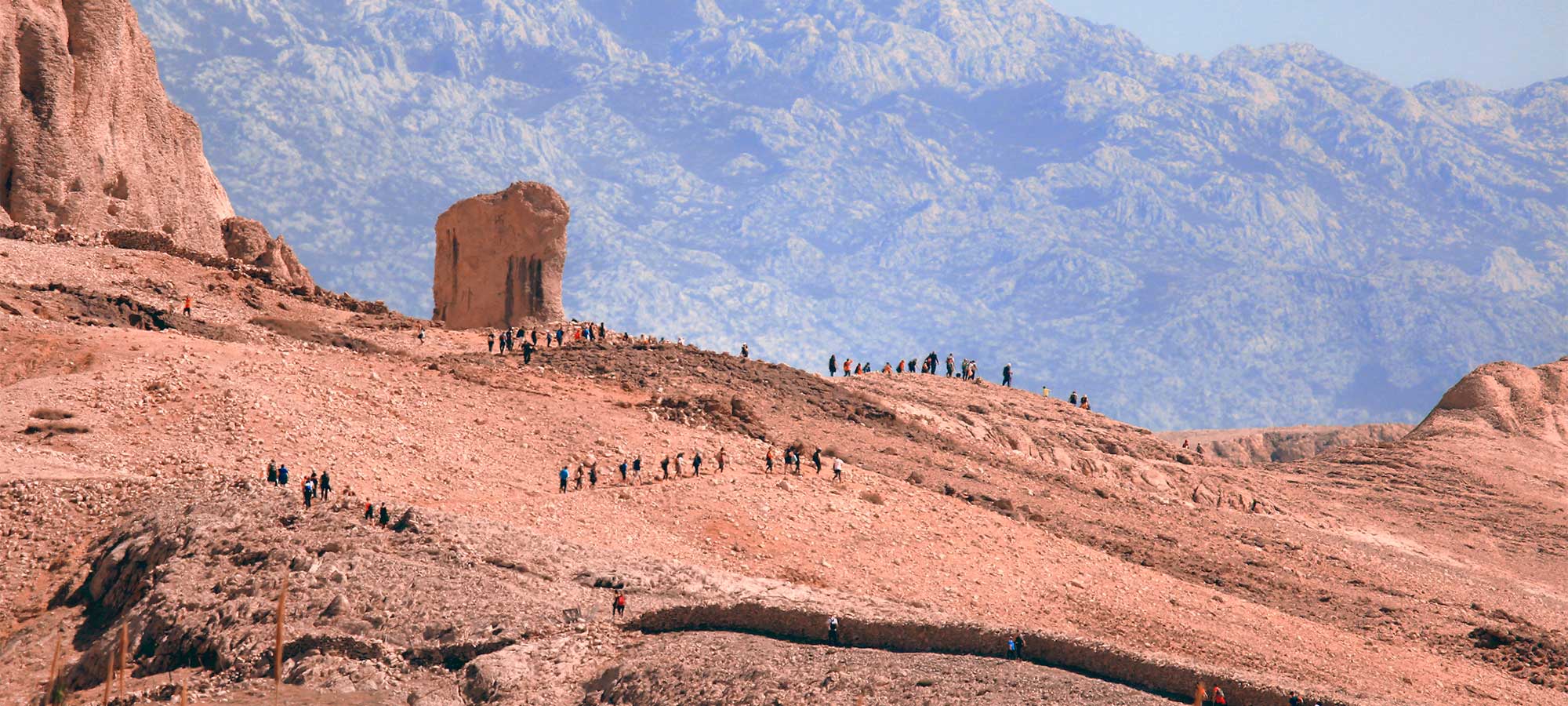
Life on Mars — The Most Unique Trail in Croatia
If you're searching for unique hiking experiences in Croatia, nothing comes close to the Life on Mars Trail on the Island of Pag.
Named for a landscape so alien, so strikingly barren, that it genuinely resembles the surface of Mars — or the Moon — this trail has become
one of the most talked-about outdoor attractions in the entire Adriatic region. Bare karst rock sculpted by centuries of bora wind and salt,
stretching to the horizon under an open sky, with the deep blue of the Adriatic cutting through the stone at every turn.
There is nothing like this anywhere else in the Mediterranean.
Officially opened in 2019 and consistently rated the most beautiful trail in Croatia, the Life on Mars Trail starts from Metajna and
leads through one of the most extraordinary coastal landscapes in Europe. The route passes above and through some of the finest beaches on the island —
Ručica, Beritnica, Slana, Malin, and Seline — each one a reward in itself, each one accessible from the trail for a swim, a break, or simply a moment of silence.
Three marked routes suit every level of fitness and ambition. The Light route covers 7 km — a moderate two-hour loop ideal for first-timers and families.
The Active route extends to 14 km for those who want more terrain and more coastline. The Challenger — 23 km of the most dramatic hiking
in Croatia, taking in the full sweep of the trail from Metajna to Malin and back — is reserved for those who come prepared.
In 2020, the trail was expanded with Croatia's first coastal Via Ferrata — a 100-metre steel-cable route along the cliffs above the sea, connecting Slana Bay to Cape Sušac.
Intended for experienced and well-equipped climbers, the ferrata transformed the trail from remarkable to genuinely unique. Above Beritnica Beach,
the spectacular Stogaj rock formation rises from the landscape — a climbers' destination with nearly 70 marked routes, ranging from introductory to advanced,
drawing climbers from across the region year after year.
Every year on the last weekend of March, the Life on Mars Trail Race brings competitors from across Croatia and beyond to Metajna —
with over 350 participants from 18 countries at its peak, it has become the largest trail race among 190 official trail events in Croatia.
Start and finish on the Metajna seafront, with music, food, and the kind of atmosphere that only a genuinely special place can generate.
Dogs are welcome on the trail year-round. The best seasons are spring and autumn — when the temperature is cooler, the light is extraordinary,
and the trail belongs almost entirely to you.
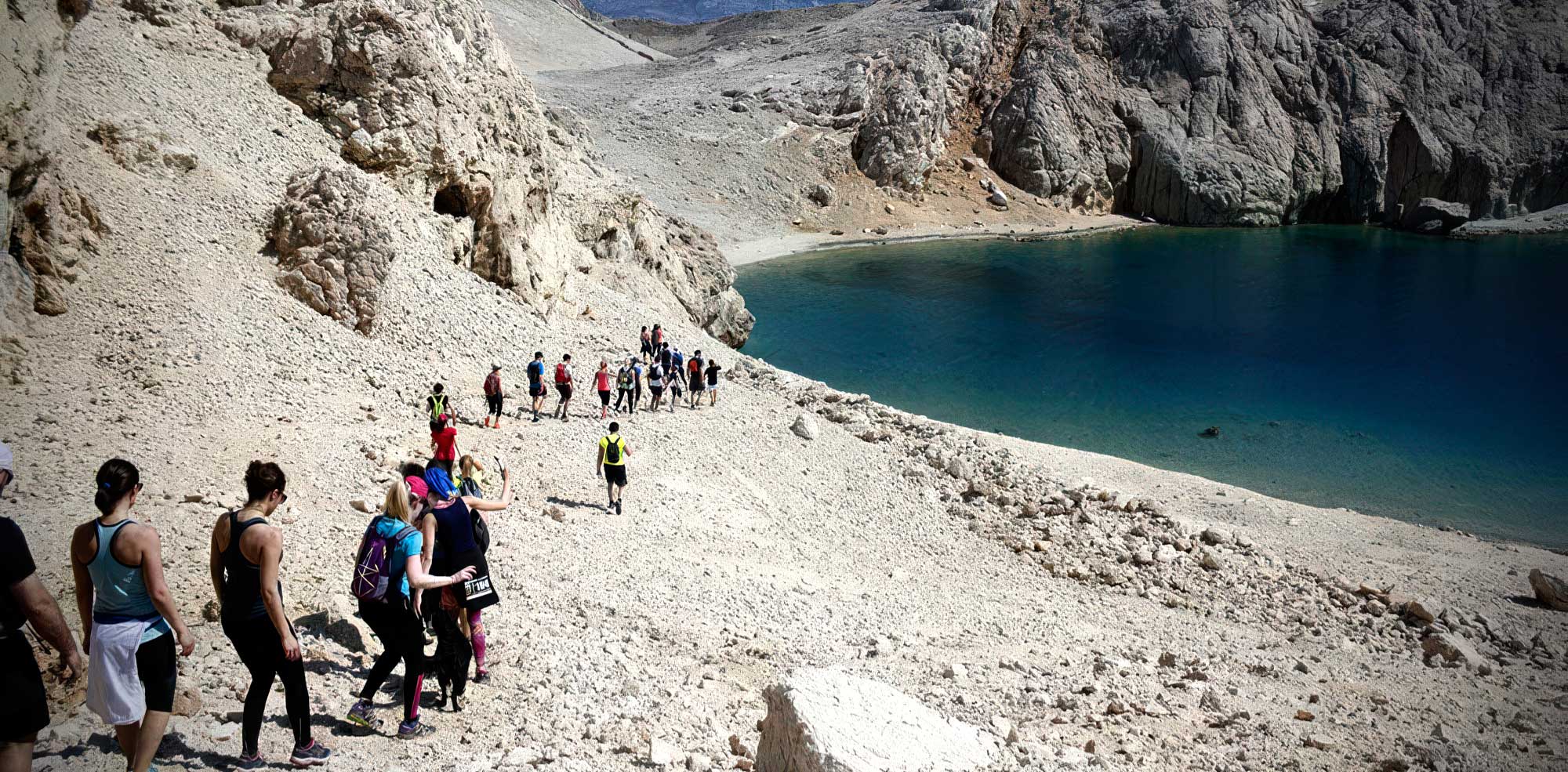
Hiking — Where Every Step Looks Like Another Planet
Metajna is one of the finest hiking destinations on the Adriatic coast — and the landscape is the reason. Bare karst rock, ancient stone walls,
the scent of sage and salt in the air, and panoramic views over the sea and the Velebit mountain range that stop experienced hikers in their tracks.
This is not a place where the trail leads you through scenery. This is a place where the scenery is the trail.
The Life on Mars Trail is the crown jewel — Croatia's most celebrated hiking route, running from Metajna along a coastline of hidden beaches and
otherworldly terrain for up to 23 km. But the hiking around Metajna extends well beyond a single trail. The rocky slopes above the village offer challenging routes
with sweeping coastal views in every direction. Night hikes along the bay, guided tours to hidden beaches, and seasonal organised walks are available throughout the year,
making Metajna a genuine year-round destination for outdoor enthusiasts.
For those wanting to go higher, Sveti Vid — at 348 metres the highest peak on the island of Pag —
offers a demanding ascent rewarded by one of the most spectacular views in the northern Adriatic: sea, islands, Velebit, and the full breadth of Pag's lunar landscape
stretching below. Dogs are welcome on all marked trails. Sturdy footwear and sufficient water are essential — the terrain is as beautiful as it is unforgiving.
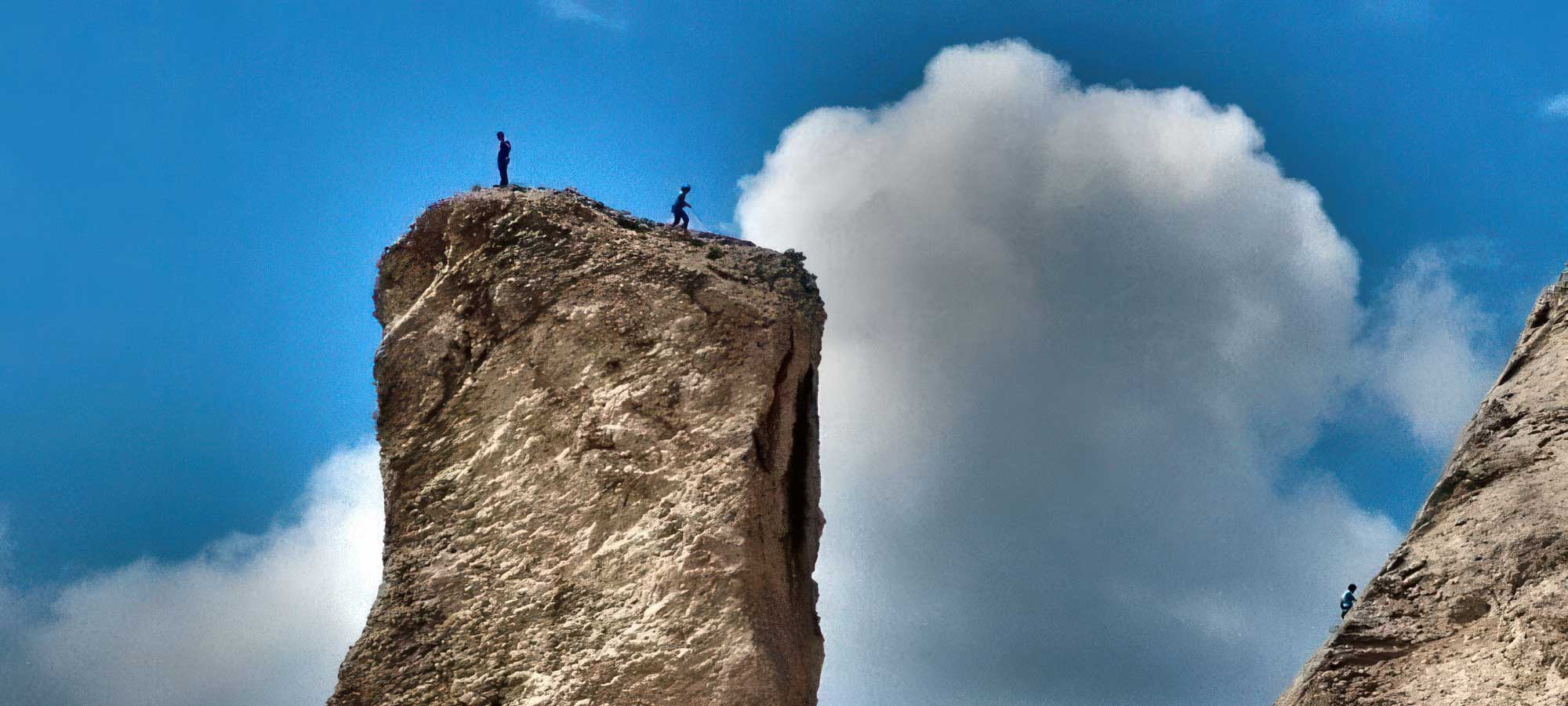
Climbing - Vertical Adventures Above the Sea
Metajna is a year-round destination for climbers, with several exposed limestone crags rising directly above the coastline just outside the village.
The rock here is typical Pag karst — sharp, sun-bleached, and full of character, with routes ranging from approachable to genuinely demanding.
The area's star attraction is Stogaj, a 60-metre vertical rock face that towers dramatically above Beritnica beach and
is considered one of the most striking climbing formations on the island. Visible from a distance along the Life on Mars Trail, Stogaj draws climbers from across Europe,
who come both for the technical challenge of the route and the reward of a spectacular sea view from the top.
Mild winters and dry summers make Metajna's climbing area accessible almost any time of year, though spring and autumn offer the most comfortable conditions.
Climbers should come prepared with their own gear — there are no rental facilities on site — and be ready for a short, scenic approach on foot along the coastal trail.

Boat Trips — Coves You Can Only Reach by Water
Some of Pag's most beautiful corners are cut off from the road entirely — reachable only by boat, and all the more rewarding because of it.
A boat trip along Metajna's coastline reveals a string of hidden bays, sheer cliffs, and pebble beaches that stay quiet even in peak season,
simply because getting there takes more than a car and a pair of legs.
Highlights along the way include the crystal-clear cove of Slano, the dramatic rock face of Stogaj rising above Beritnica beach,
and the striking coastal formation known as the Rushmore of the Adriatic near Cape Sušac —
a stretch of coast best appreciated from the sea, where the full scale and colour of the cliffs come into view.
Whether you charter a boat, rent a kayak, or join a guided tour, exploring this coastline by water is the only way to see Metajna the way it's meant to be seen —
quiet, wild, and completely on its own terms.
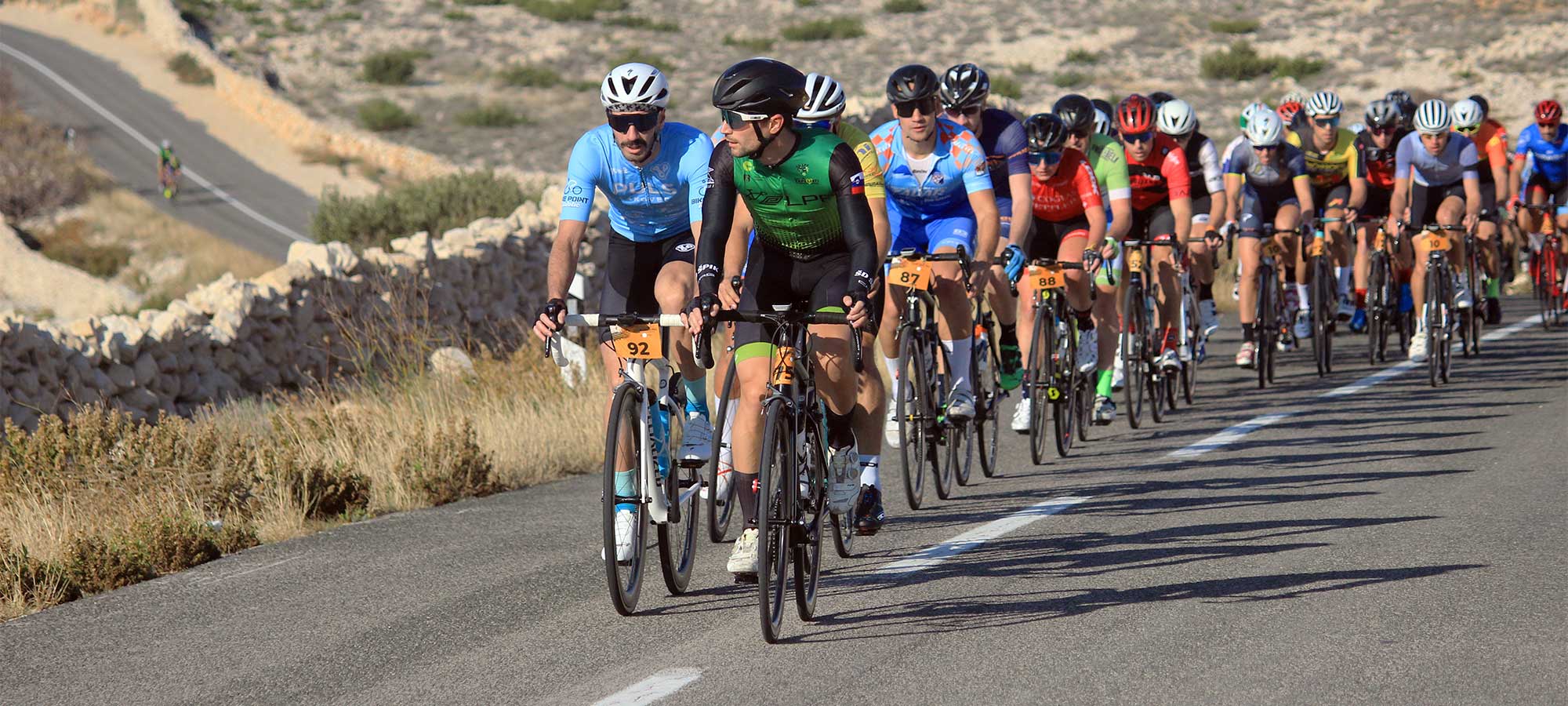
Cycling — Riding Across a Lunar Landscape
Metajna's surrounding terrain offers both coastal and off-road cycling routes across some of the most unique karst landscape in Croatia —
a mix of asphalt and rugged gravel tracks that wind through stark, otherworldly scenery unlike anywhere else on the Adriatic.
Every October, this terrain takes centre stage in the Granfondo Pag — nicknamed "Cycling on the Moon" —
an international road cycling marathon that passes directly through Metajna on its route around the island.
Riders from across Europe take on this demanding course for the challenge of the ride and the reward of racing through Pag's dramatic, moon-like landscape.
Outside race season, the same routes remain open to recreational cyclists year-round, offering a quieter but equally striking way to experience the terrain
that makes this corner of Pag so distinctive.

Snorkeling — A Window Into the Underwater World
The same crystal-clear waters that make Metajna's beaches so striking continue well beneath the surface. Along this stretch of coast, sheer underwater cliffs,
submerged rock formations, and pockets of Posidonia seagrass create a rich habitat for marine life — from small schools of fish to sea urchins, starfish,
and the occasional octopus tucked into the rocks.
Coves like Slano and Beritnica are especially well suited to snorkeling, with visibility often extending several metres down
thanks to the absence of sand or silt — just clean gravel, stone, and open water. Because much of this coastline is reachable only by boat or on foot,
the underwater world here stays largely undisturbed, making it a rewarding stop for anyone willing to bring a mask and fins along on their walk or boat trip.
No special experience or equipment is required — just curiosity, and a willingness to look a little closer at what's beneath the surface.
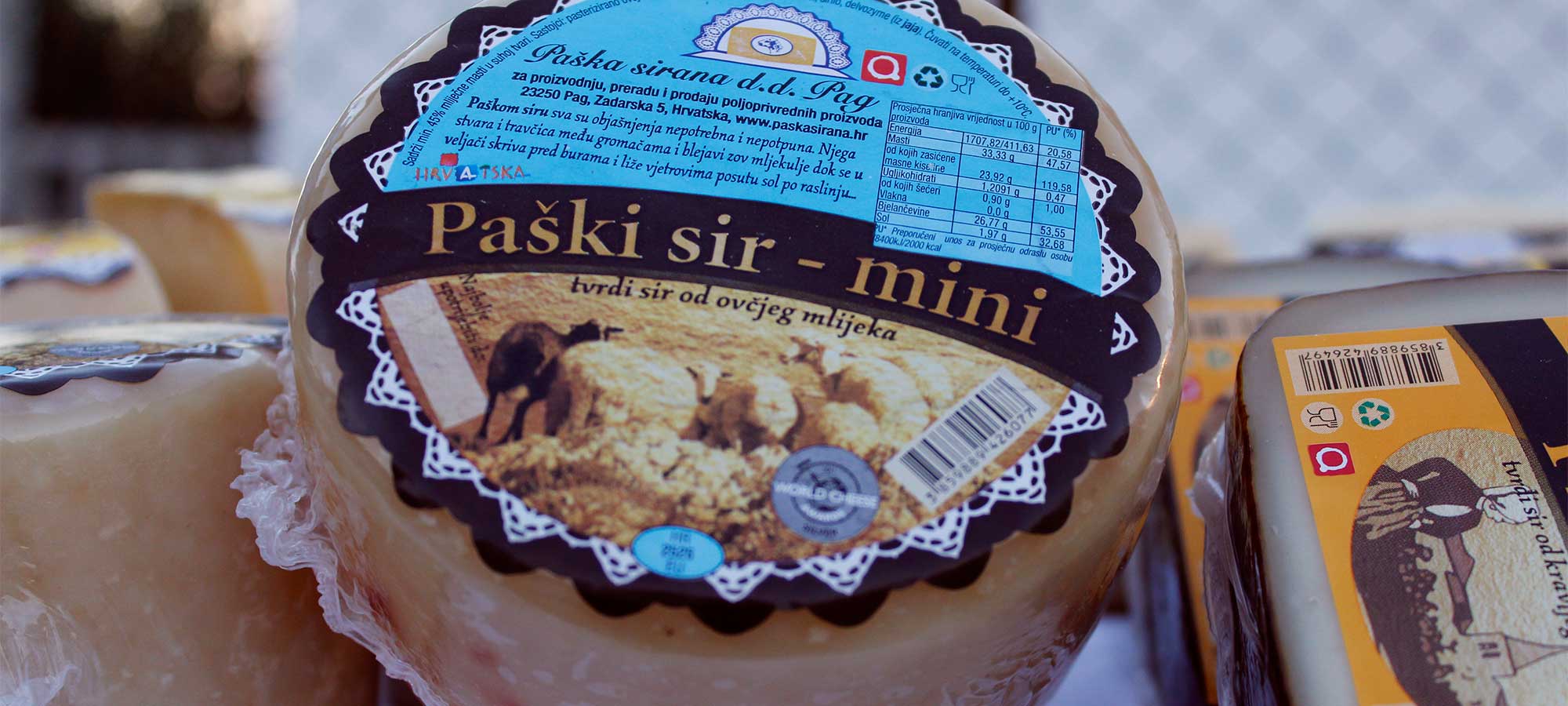
Local Cuisine — A Taste of the Island's Tradition
Metajna and the surrounding island offer a genuine taste of Pag's culinary heritage — fresh seafood straight from the Adriatic,
tender Pag lamb raised on wild herbs and sea salt, aromatic olive oil, and above all, the island's crown jewel: Pag cheese (Paški sir).
Made from the milk of sheep that graze on salt-sprayed, herb-covered pastures, Pag cheese carries a distinctive, slightly salty flavour found nowhere else —
a result of the island's unique terroir. It holds a protected designation of origin in Croatia,
and consistently wins top honours at international cheese competitions, including a Super Gold medal at the World Cheese Awards.
Whether paired with local olive oil, honey, or a glass of island wine, tasting Pag cheese where it's made is an essential part of understanding Metajna —
and the island's rugged, salt-shaped identity.

Photography — Where Every Frame Tells a Story
Few places on the Adriatic offer as much visual range as the coastline around Metajna. The contrast is what makes it —
the stark white and reddish karst stone against the deep blue of the sea, framed by skies that shift from bright Mediterranean noon to a dramatic,
fiery gold by evening.
The terrain itself is the main subject: wind-carved rock formations along the Life on Mars Trail,
the sculptural silhouette of the Rushmore of the Adriatic, the sheer face of Stogaj rising above Beritnica beach,
and secluded coves like Slano where the water turns an almost impossible turquoise. Add in the island's ever-present sheep, wandering freely across the barren landscape,
and the scene rarely needs staging.
For sunsets specifically, Zaglava beach is one of the finest vantage points in the area — its quiet, pine-shaded coves face open water,
making it a favourite among photographers waiting for that last hour of light. Golden hour is when Metajna truly comes alive:
the low sun sets the red-tinted stone ablaze and casts long shadows across the ridges, while sunsets over the Velebit Channel paint the sky in shades few places can match.
And when the sun goes down completely, Metajna reveals something increasingly rare on the Adriatic coast: genuinely dark skies.
Far from any major town or significant artificial light, this remote corner of Pag is a proven spot for night sky photography — on clear, moonless nights,
the Milky Way stretches clearly overhead, visible to the naked eye and a rewarding subject for long exposures.
Whether you're shooting with a phone or a full kit, chasing golden hour on the coast or the stars above it, this is a landscape built for patience, timing,
and a good eye for light.
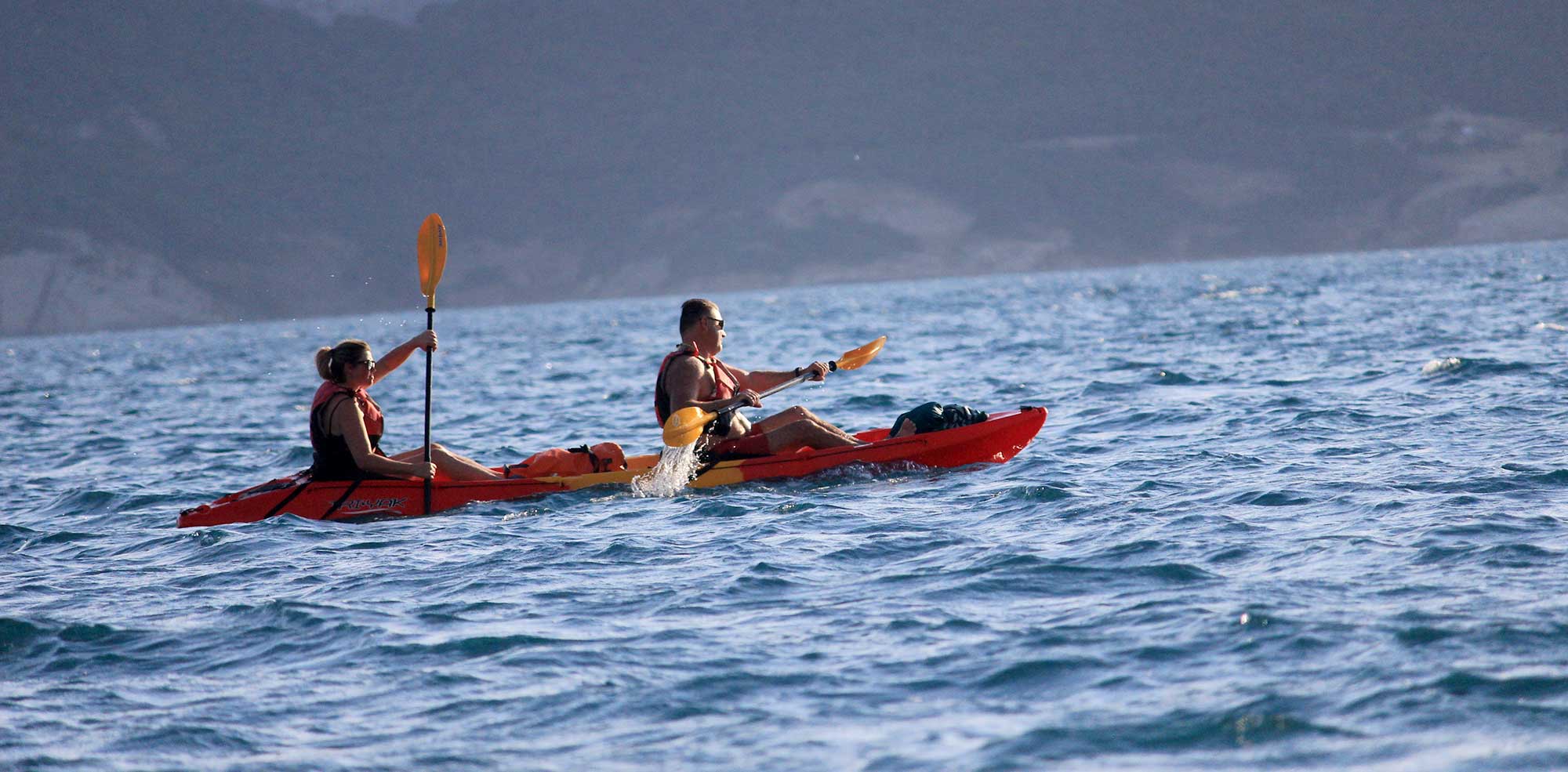
Kayaking — Paddling Into Hidden Corners of the Bay
Kayaks are the perfect way to explore the interesting hidden coves along the Bay of Pag and its entrance into the Velebit Channel —
reaching stretches of coastline that stay completely inaccessible by road or foot.
A classic route sets off from Ručica beach, following the bay's edge south-east along the coast toward Beritnica,
known for its three natural stone formations rising from the sea and the towering climbing cliff of Stogaj above it. From there,
the route continues on to Slana, one of the most secluded coves on this side of the island — reachable comfortably only by water,
and all the more rewarding for it.
Paddling this stretch reveals a side of Metajna few visitors ever see: dramatic cliffs rising straight from the water,
crystal-clear coves too small or too remote for beach crowds, and the occasional curious sheep watching from the rocks above.
Whether you bring your own kayak or join a guided tour, this route is one of the best ways to experience the raw, untouched character of the Pag Bay coastline.
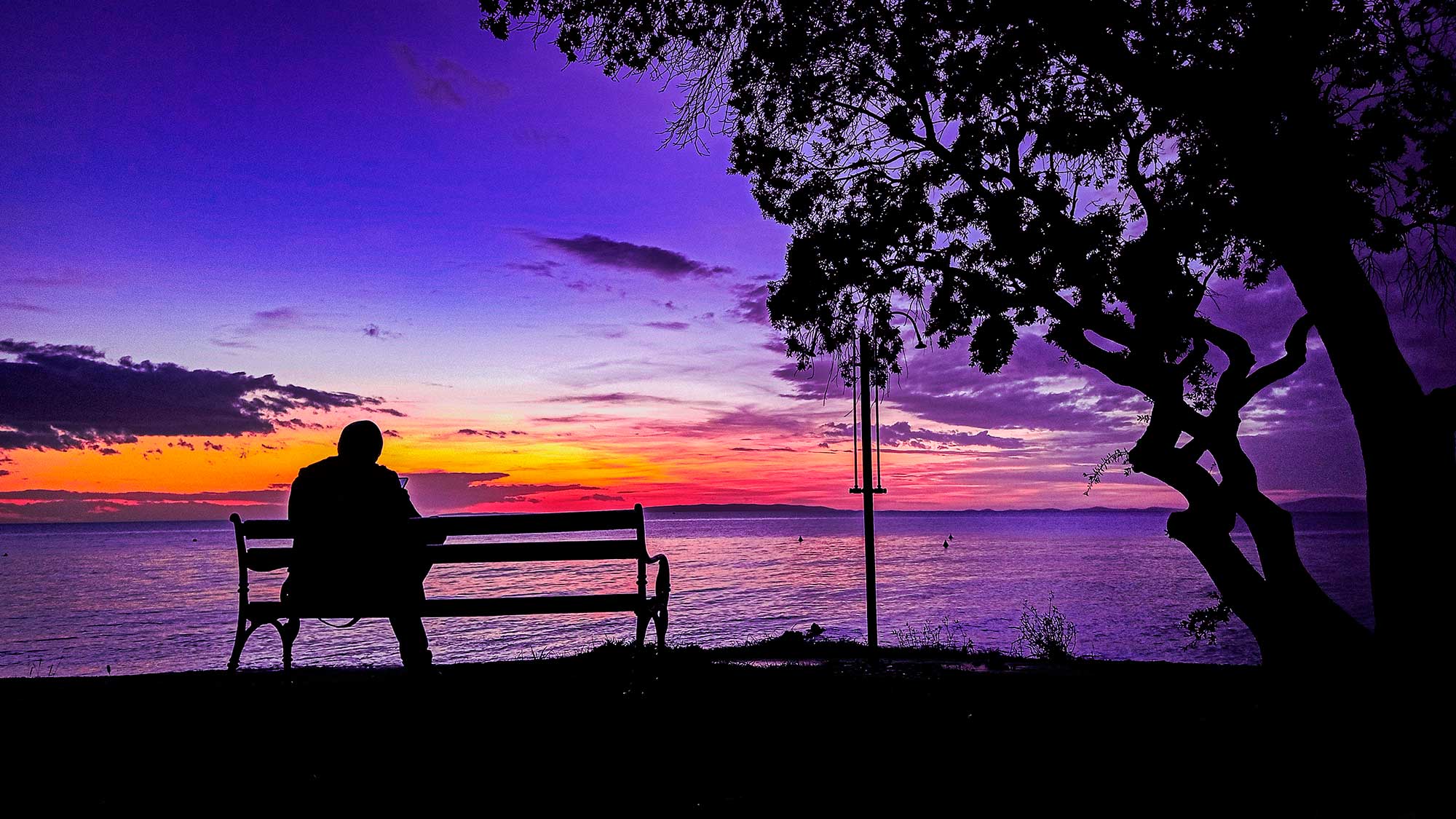
Resting — A Moment to Simply Be
Not every part of a journey needs a destination. Somewhere along the coast, under the shade of an old tree, a bench faces the open sea —
and every evening, it quietly offers the same invitation: sit down, slow down, and watch the sky do the rest.
There's a particular kind of stillness here that's hard to find elsewhere — no rush, no schedule,
just the sound of water against the shore and the sky slipping from gold to crimson to deep violet.
Whether it's the end of a long hike, a day spent exploring hidden coves, or simply a quiet evening in Metajna, this is where the island asks you to stop,
breathe, and let the moment last a little longer.
Some of the best memories of this place aren't the ones captured mid-adventure — they're the ones made sitting still, watching the sun disappear into the Adriatic.
Beaches Around the Island
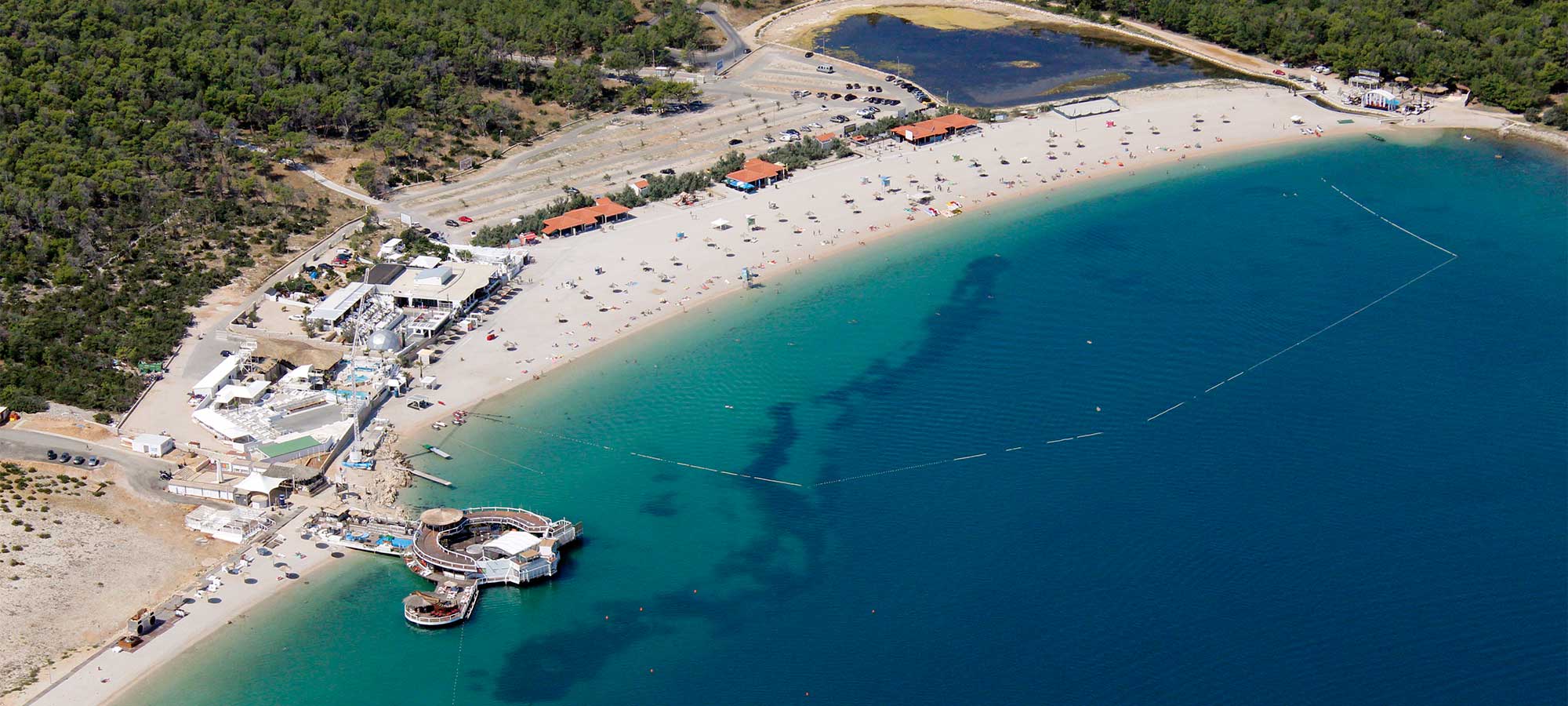
Zrće Beach — Croatia's Legendary Party Beach
Just outside Novalja lies Zrće, one of the most famous stretches of coastline in Croatia —
a long pebble beach that has earned its reputation as "the Croatian Ibiza."
By day, it's a Blue Flag beach with clear Adriatic water and space for sunbathing and water sports; by night,
it transforms into one of Europe's leading party destinations.
Home to open-air clubs such as Aquarius, Papaya, Kalypso, and Noa — several of them regulars on the DJ Mag Top 100 club list —
Zrće hosts world-renowned DJs and major international festivals throughout the summer, including Hideout, Sonus, and Fresh Island.
From Spring Break events in May through non-stop beach parties into September, the energy here rarely lets up.
Whether you're looking for daytime relaxation by the sea or an all-night dance floor under the stars,
Zrće delivers a side of Pag that couldn't be more different from Metajna's quiet coves — proof of just how much variety this island packs into one stretch of coastline.
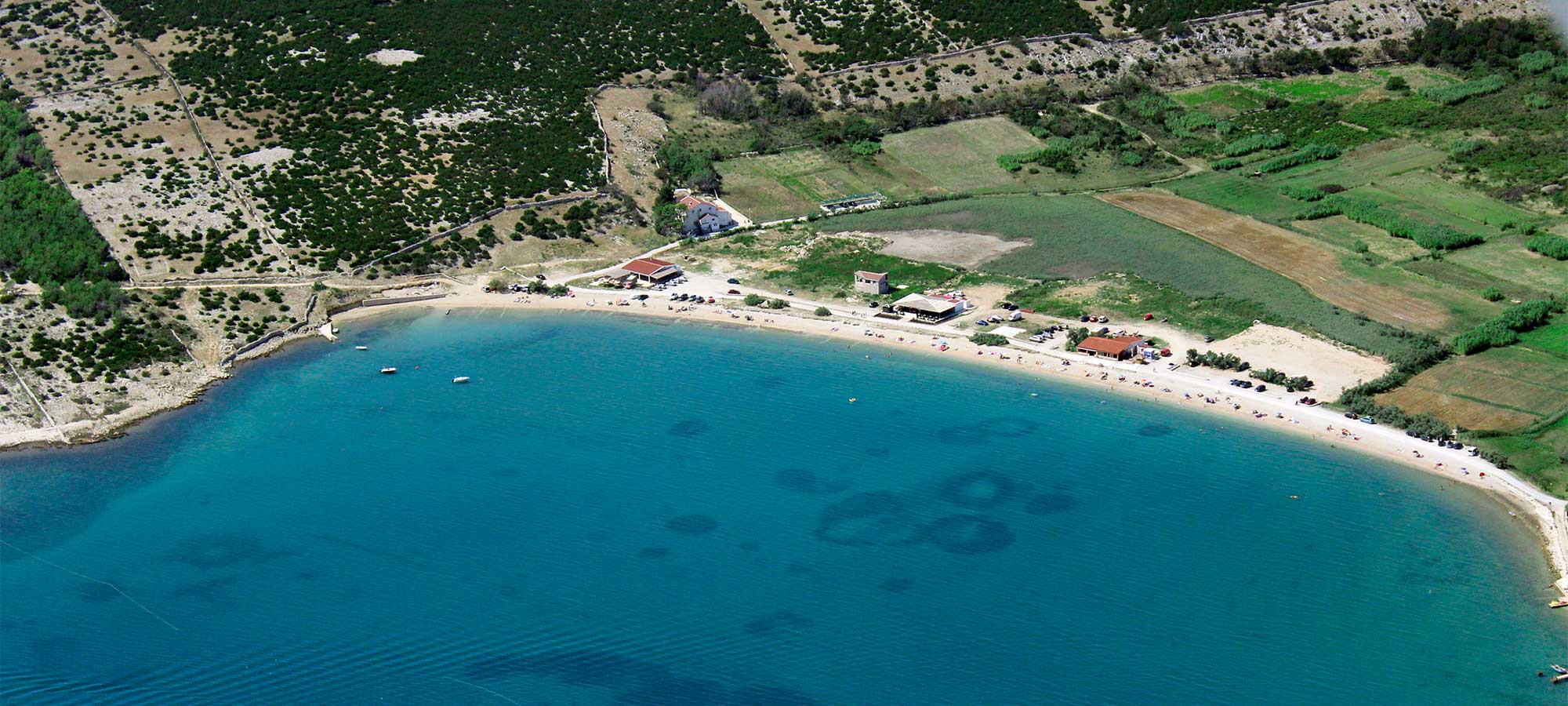
Caska Beach — The Bay That Swallowed a City
Few beaches in Croatia carry a story quite like Caska. This quiet bay near Novalja was once home to Cissa, a significant Roman-era town —
believed, according to historians, to have sunk beneath the sea following a major earthquake in the 4th century AD.
Today, the remains of Cissa still lie on the seabed roughly 15 metres down, making Caska one of the most fascinating diving sites on the Adriatic coast,
though much of the ancient city remains hidden beneath centuries of silt, sand, and seagrass.
On the beach itself stands Tunera, a distinctive round stone tower built in 1888 as a tuna-spotting lookout — a later addition to Caska's history,
but a striking landmark and unofficial symbol of the bay in its own right. Higher up, on the hill overlooking the beach, lie the ruins of the
Romanesque Church of St. George, built using a wealth of early medieval and early Christian architectural fragments —
a reminder of just how many layers of history are packed into this small stretch of coast.
Between the sunken city below the waves, the historic watchtower on the shore, and the ancient church ruins above, Caska offers something rare on the Adriatic:
a beach where history isn't just nearby — it's beneath your feet, above your head, and all around you.
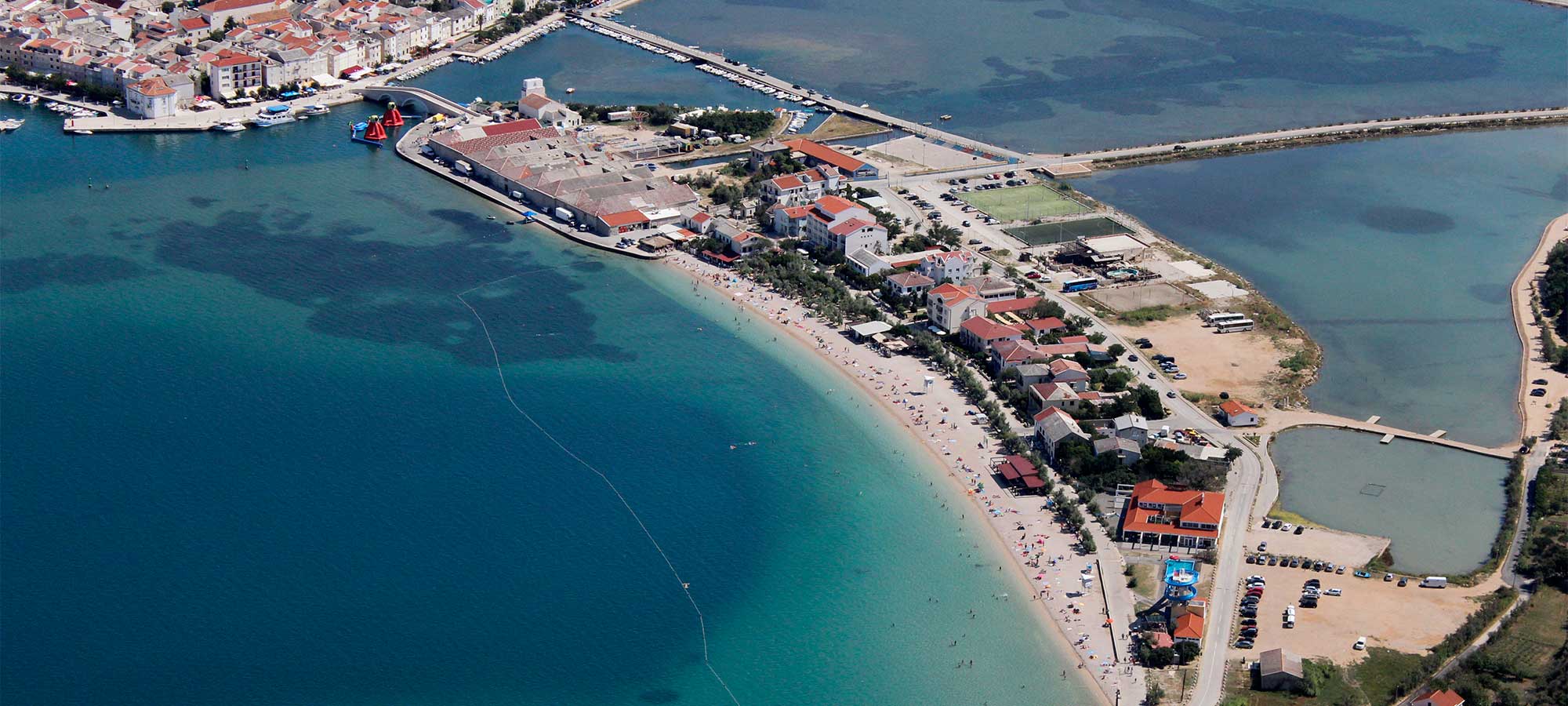
Prosika Beach — Pag Island's Top Windsurfing Destination
Prosika Beach is the kind of place that works for everyone — and does it with ease. Stretching 800 metres of fine sand and
gravel along the waterfront just minutes from the centre of Pag town, it is the largest sandy beach in the area and one of the most complete beach experiences
on the island. Shallow, calm, and family-friendly at the shoreline — and increasingly exhilarating further out,
where the consistent Adriatic winds turn the bay into one of the finest windsurfing spots in Croatia.
The combination of steady winds, a sandy entry point, and shallow water makes Prosika a natural choice for windsurfers and kitesurfers of all levels —
from beginners finding their feet to experienced riders looking for reliable conditions. The same winds that make Pag's landscape so dramatically bare make its waters
a playground for anyone who knows how to use them.
On shore, the beach is equally well equipped. Tennis courts, beach volleyball, a waterpark with slides, a children's playground, cafés and restaurants —
everything a full beach day requires, with natural shade provided by the surrounding landscape. Free entry, easy parking,
and a lifeguard on duty in season complete the picture.
For visitors exploring both Metajna and the historic town of Pag, Prosika Beach is the perfect complement — a lively,
fully-equipped beach just minutes from Pag's salt pans, UNESCO lace heritage, and centuries-old stone streets.
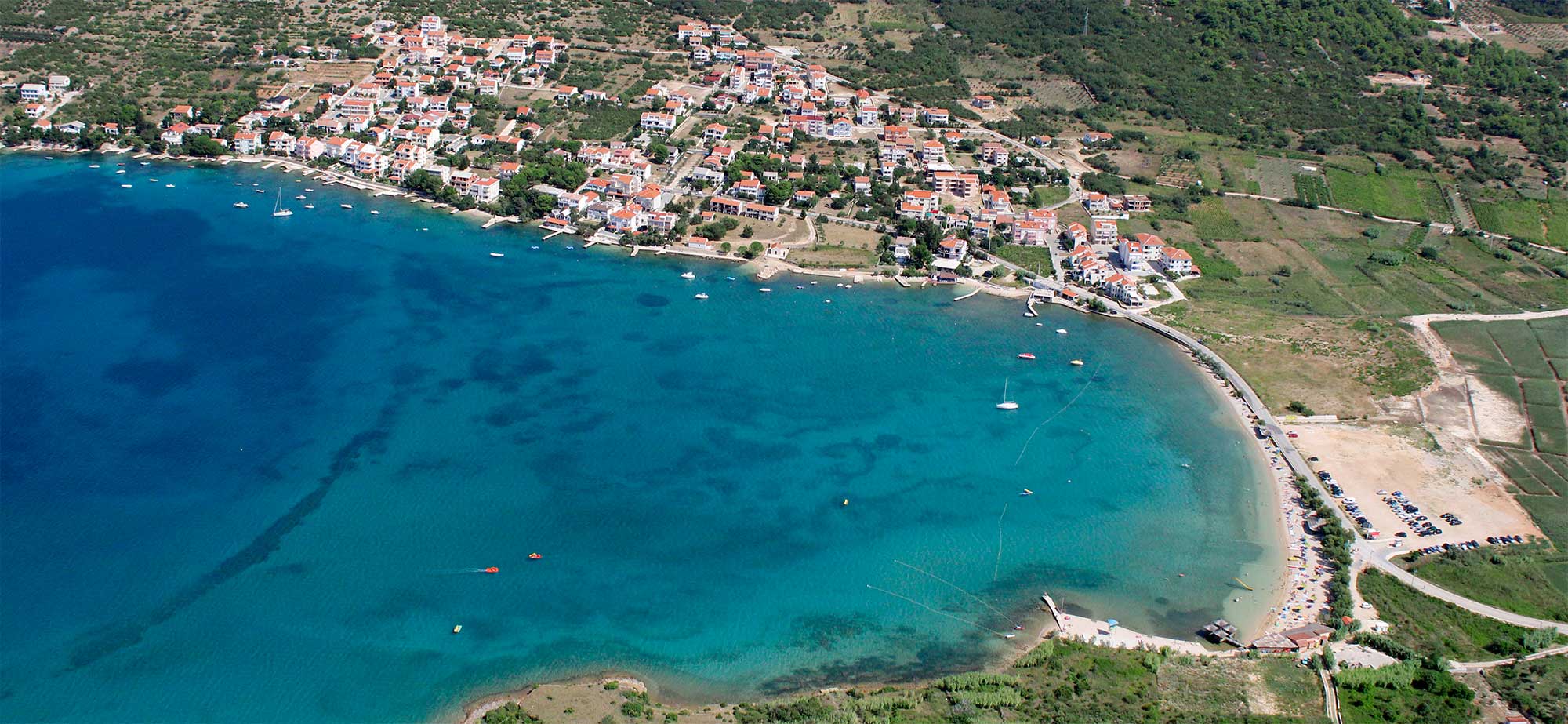
Planjka Beach — Pag Island's Blue Flag Family Beach
Known by two names — Planjka to locals, Trinćel to those who've been coming for years —
this 300-metre stretch of fine sand and gravel tucked into a sheltered cove just 3 kilometres north of Novalja is one of the most decorated beaches
on the Island of Pag. Holder of the prestigious Blue Flag since 2004, and winner of both the Best Kept and
Most Beautiful Beach on the Adriatic awards, Planjka has earned its reputation the hard way — by being genuinely excellent, year after year.
The water is warm, shallow, and crystal clear — exactly what families with young children need. The gentle slope means safe entry for little ones, and the calm,
sheltered bay keeps conditions comfortable even when the wind picks up elsewhere on the island. Lifeguards on duty throughout the season add an extra layer of reassurance.
Beyond the water, Planjka delivers everything a complete beach day requires. Sun loungers and umbrellas for rent, showers, changing cabins, a waterpark with slides,
paddle boats, SUP boards, jet ski, football and volleyball courts, and Restaurant Shark — a seafront restaurant shaped like a boat,
serving everything from fresh Adriatic fish to pizza and pasta right at the water's edge.
For visitors based in Metajna looking for a fully-equipped family beach within easy reach, Planjka is the answer — the amenities of a resort beach,
the water quality of an unspoiled cove, and the character of a place that has been welcoming families to Pag island for decades.
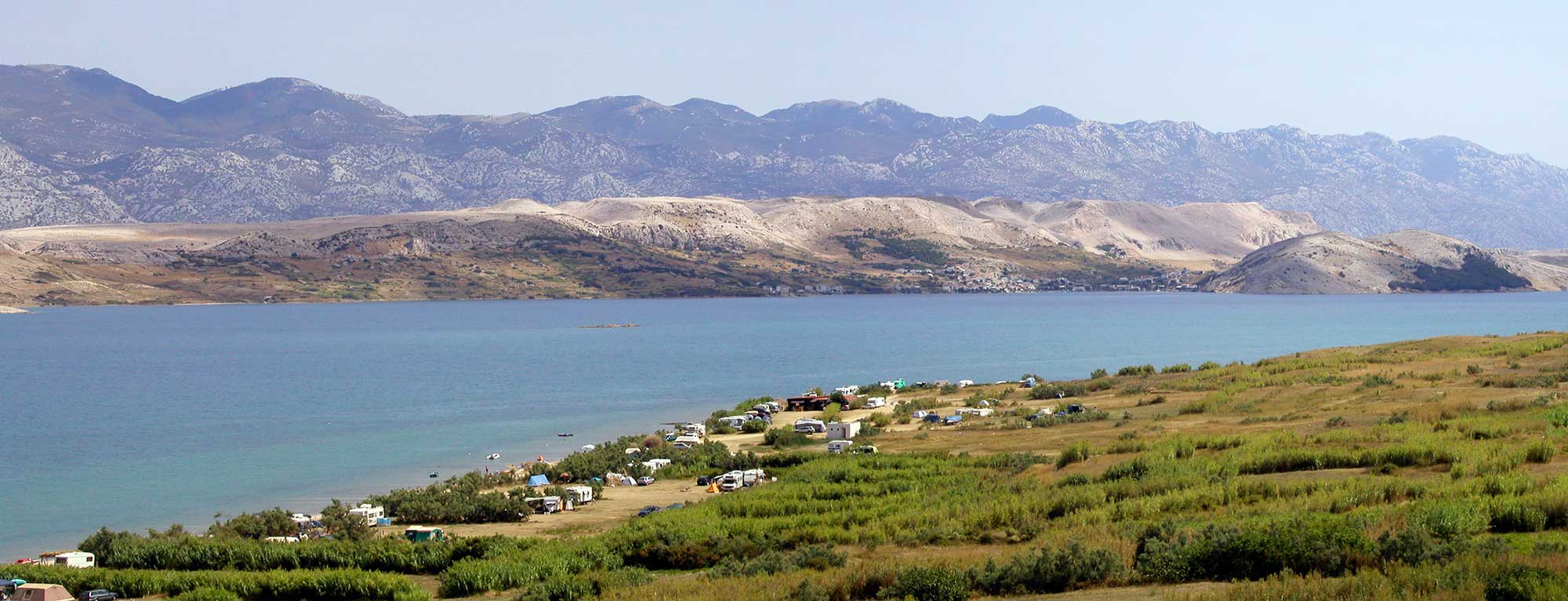
Sveti Duh Beach — Where the Sea Stays Shallow and the World Stays Quiet
Sveti Duh — Holy Spirit — is a name that fits. There is something almost sacred about the calm that settles over this elongated
pebble-and-sand beach on the western coast of Pag island, about 15 kilometres from Pag town. No crowds, no noise, no performance.
Just 2.4 kilometres of clean coastline, crystal-clear water, and a view across Pag Bay toward the Velebit mountain range that makes
every other thought temporarily unnecessary.
The beach is exceptionally well suited to families with young children. The shallows here extend up to 50 metres from the shoreline —
one of the most gradual and child-friendly entries on the entire island — and the water remains warm, calm, and invitingly clear throughout the season.
Fine gravel and sand underfoot, no aqua socks required, no surprises. Just easy, comfortable swimming in some of the cleanest water on the Adriatic.
A small church stands nearby — the modest stone chapel of Sveti Duh, Holy Spirit, from which the beach takes its name — adding a quiet layer of history and
character to a place that already has plenty of both. The surrounding landscape is lush and green by Pag standards, a welcome contrast to the bare karst
that defines much of the island.
The beach is part of Terra Park SpiritoS, a fully equipped campsite offering pitches, modern mobile homes for rent, a beach bar and restaurant, aquapark,
showers, changing cabins, and sunbed rentals. For those looking for something more permanent, the campsite also offers mobile homes for purchase —
a rare opportunity to secure your own piece of this quiet corner of Pag island. Quiet by choice, beautiful by nature — Sveti Duh is the kind of beach
that regular visitors return to year after year, without needing to explain why.
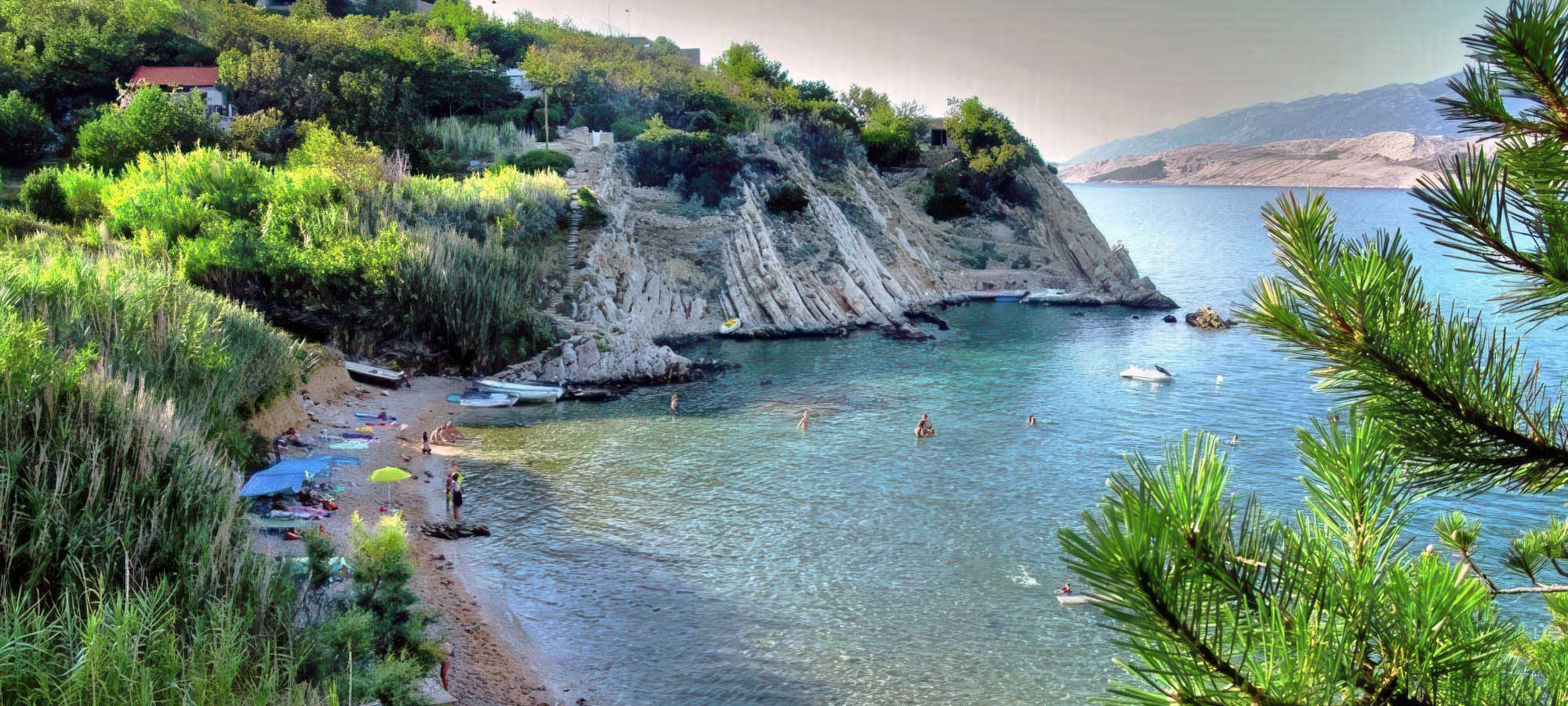
Bošana Beach — Pag Island's Most Dramatic Hidden Cove
There are beaches you find easily, and there are beaches that make you work for them. Bošana Beach, tucked beneath steep rocks
about 5 kilometres north of Pag town, firmly belongs to the second category — and is all the more rewarding for it.
A steep descent of around 120 steps leads down to a series of small pebble coves wedged between dramatic cliffs that plunge directly into the sea,
shielding bathers from the world above in a natural enclosure of rock, water, and silence.
The water here is exceptional — crystal clear, surprisingly cool thanks to freshwater springs that feed into the bay from beneath the rocks,
and ideal for snorkeling among the stone formations that line the seabed. Visitors consistently rate Bošana as one of the finest snorkeling spots on the island,
and the dramatic underwater scenery backs that reputation entirely. No facilities, no sunbeds, no entrance fee — just raw, untouched Adriatic coastline at its finest.
Directly behind the beach lies Dubrava-Hanzine, a protected Special Forest Reserve and the only place in the Pag area
that preserves the remains of the original holm oak forest. The vegetation here has developed unique genetic resistance to the island's fierce bora wind and sea salt —
a botanical rarity that scientists have found contains previously unrecorded genetic material. Standing between that ancient forest and that extraordinary sea,
it is easy to understand why.
Not easy to find, not easy to reach — and completely worth it. Bošana Beach is one of those places that regular visitors to Pag island keep
quietly to themselves.
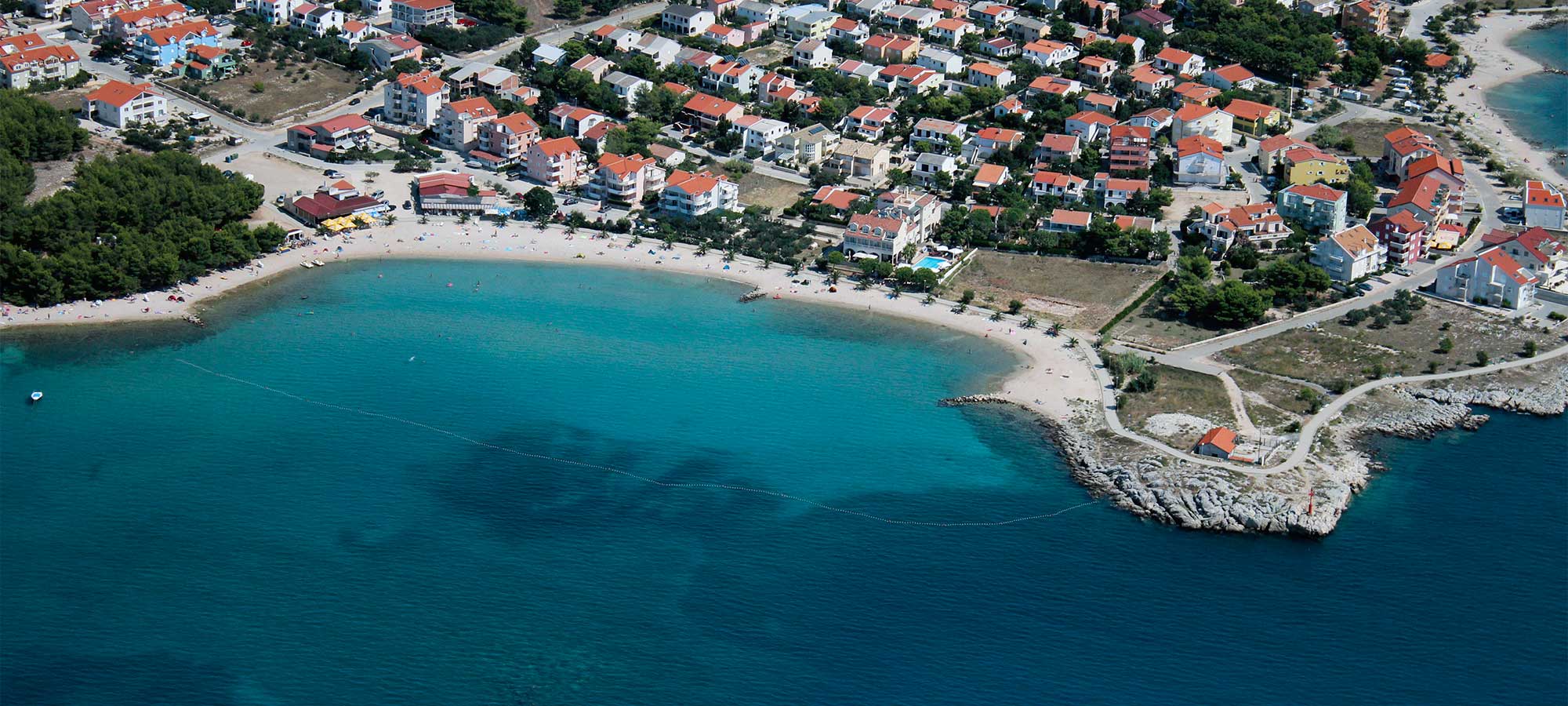
Povljana Beach — Pag Island's Sandy Green Oasis
On an island defined by bare karst rock and lunar landscapes, Povljana comes as a gentle surprise. Tucked into the southwestern coast of Pag,
just minutes from the bridge connecting the island to the mainland, this is one of the rare places on the island where the land is genuinely green —
a fertile pocket of vineyards, freshwater sources, and Mediterranean vegetation that has fed the island for centuries and today offers
one of its most relaxed and family-friendly coastal experiences.
The beach itself is one of the few genuinely sandy stretches on the entire island — long, shallow, and perfectly suited to families with small children.
The sea entry is gradual and gentle, the water warm and clear, and the surrounding palm trees provide natural shade that is equally rare on Pag.
A seaside promenade runs along the shore, connecting the main beach to Mali Dubrovnik Beach further along the coast —
ideal for an evening walk with the sea on one side and the village on the other.
What sets Povljana apart from other beach destinations on the island is its extraordinary natural surroundings. Just west of the village,
Lake Segal holds therapeutic mud known locally for its skin-healing and rheumatic properties — a natural spa that has been used for generations.
And for birdwatchers, the nearby ornithological reserves of Veliko Blato and Malo Blato are among the finest
wetland habitats in the northern Adriatic, home to over 163 recorded bird species including grey heron, spoonbill, glossy ibis, and ferruginous duck —
an extraordinary natural spectacle in the shadow of a beach destination.
Restaurants, showers, changing cabins, and a relaxed local atmosphere — Povljana is the quiet, verdant counterpoint to the dramatic wild coast of northern Pag,
and one of the best family destinations on the island.
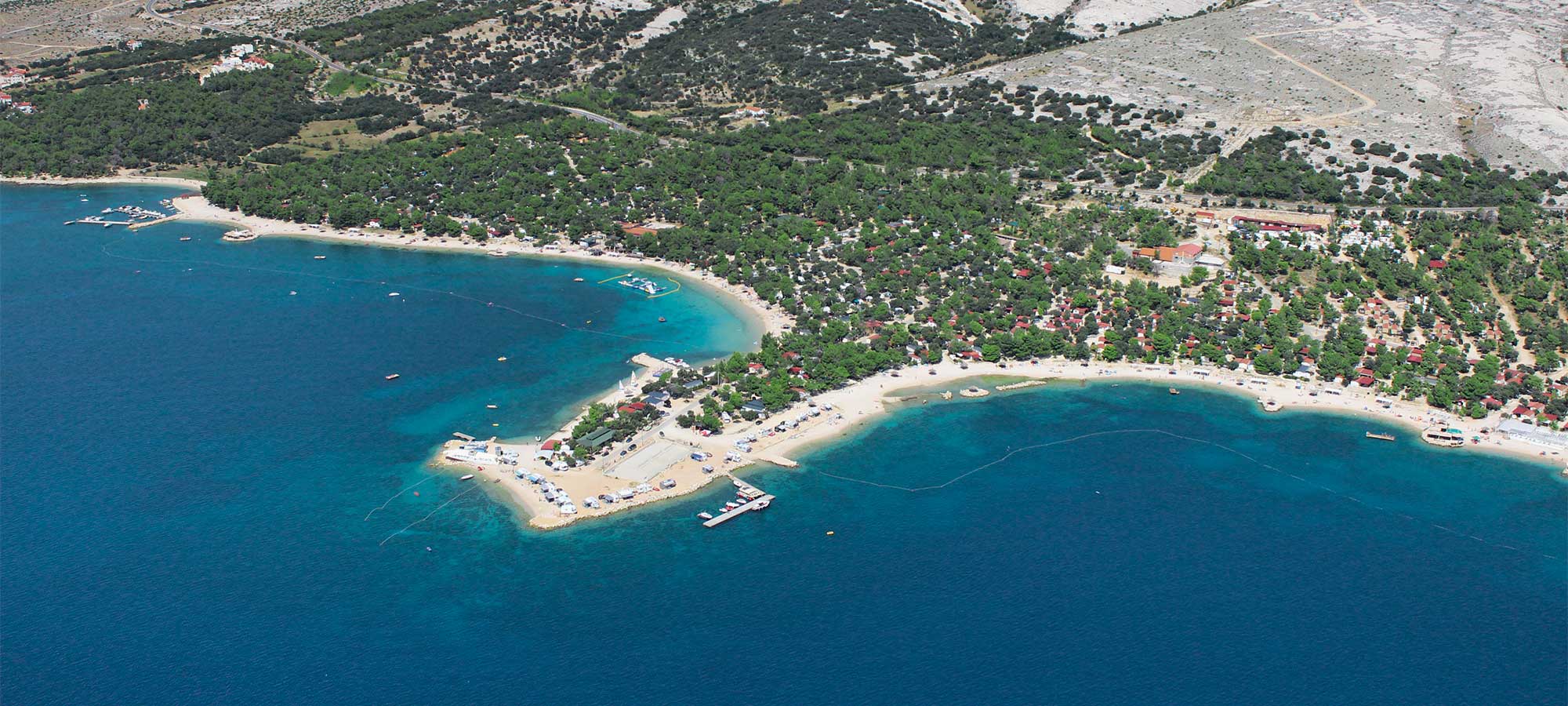
Šimuni Beach — Where Sailors Drop Anchor and Campers Never Want to Leave
Šimuni is a village of three bays — and each one tells a different story. In the northern bay, the
ACI Nautical Marina Šimuni operates year-round as one of the safest and most sheltered harbours on the entire Adriatic coast,
a favourite stop for sailors navigating the island chain between Rab and Zadar. In the central bay, fishing boats come and go and
a daily fish market sells whatever was caught that morning. And in the southern bay, a gentle pebble beach lined with natural pine shade —
a rare luxury on Pag — offers one of the most relaxed and comfortable bathing spots on the island.
The village beach is pleasant and sheltered, but the real story of Šimuni's coastline begins just beyond it, where Camping Village Šimuni
stretches across 35 hectares of holm oak and pine forest descending in terraced pitches toward the sea. Seven protected pebble beaches run along 3 kilometres
of pristine Adriatic coastline, with free parasols and sunbeds, floating safety barriers, and views across the water to the islands of Maun, Silba, and Olib.
Featured in The Guardian's Top 10 Places to Camp by the Beach in the world, Šimuni camp has been drawing loyal guests from across Europe for decades —
many of whom return year after year without needing to explain why.
Water sports, diving, windsurfing, kayaking, an aquapark, restaurants, bars, a grocery store, a fish market, and a full animation programme for children —
the camp functions as a complete holiday village in its own right, set within some of the most beautiful coastal landscape on the island.
Mooring for boats is also available directly at the camp marina.
For sailors, campers, and anyone seeking a genuinely relaxed corner of Pag with serious natural beauty and zero pretension — Šimuni delivers every time.
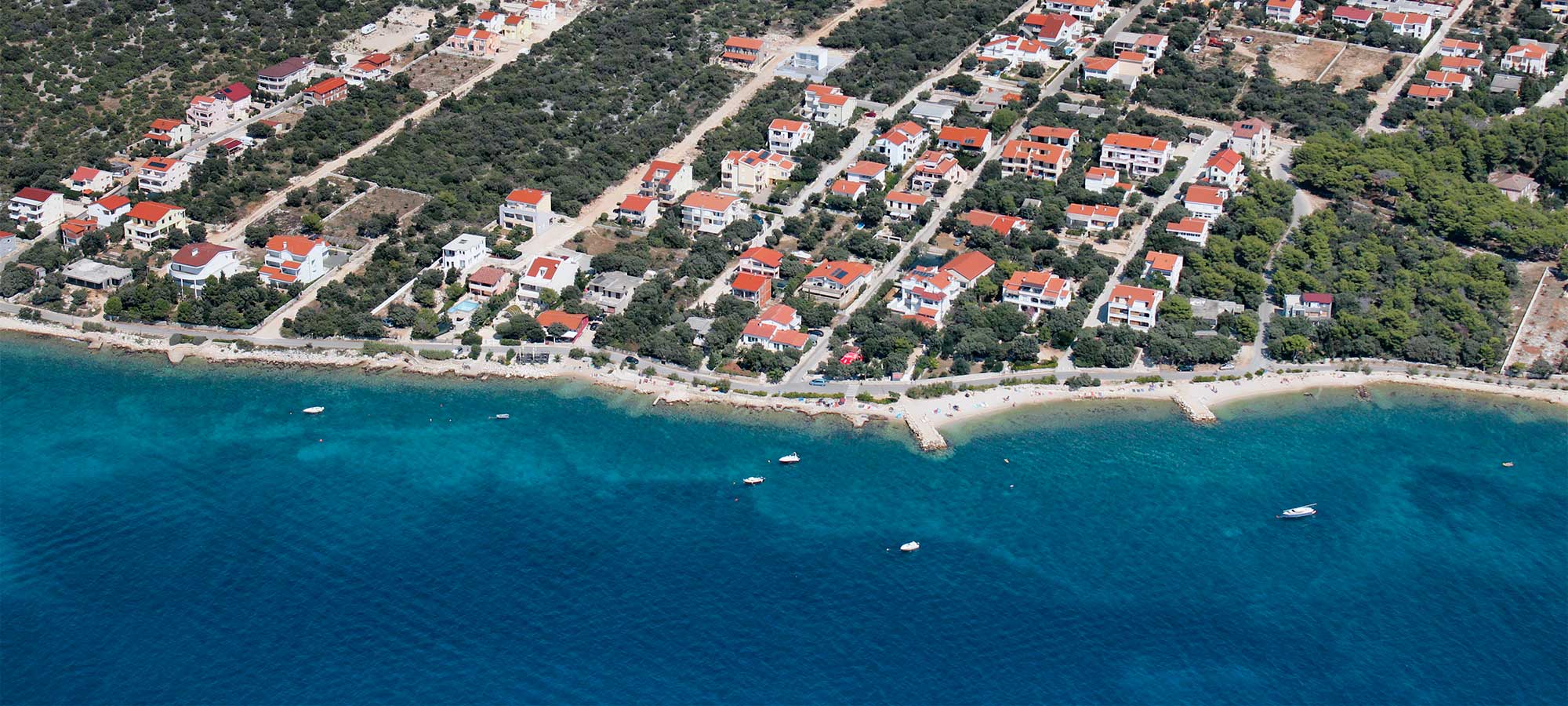
Mandre Beach — The Promenade Beach of Pag Island
Mandre is the kind of place that works its way into your daily rhythm without you noticing. A small tourist town on the southwestern coast
of Pag, halfway between Šimuni and the Pag bridge, it stretches along the waterfront in a long, easy curve of fine gravel and sand backed by pine trees and
tamarisk — one of the most naturally shaded beaches on the island, and one of the most relaxed.
The beach runs the full length of the coastal road, with restaurants, cafés, and bars opening directly onto the shore — making it effortlessly convenient for a long lunch,
a morning coffee by the water, or an evening drink as the sun drops toward the open sea. No effort required. Everything is right there.
The view across to the islands of Silba, Olib, Maun, and Škrda — an archipelago of uninhabited green islands — stretches across the water like a painting
that changes colour throughout the day.
At the centre of the village, Mala Mandra is a small sheltered bay protected from motorboats and jet skis, holder of the Blue Flag
since 2006, and particularly well suited to families with children and guests with disabilities thanks to its exceptionally accessible sea entry. Beyond the village,
more than 3 kilometres of beaches and coves extend along the coastline, and a short boat ride opens up the pristine beaches of the nearby uninhabited islands —
some of the most untouched swimming spots in the northern Adriatic.
Winner of the most beautiful place in Zadar County award, Mandre is the quiet, pine-shaded, waterfront alternative to the busier beach destinations on Pag —
and one of the most consistently pleasant places on the island to simply be.
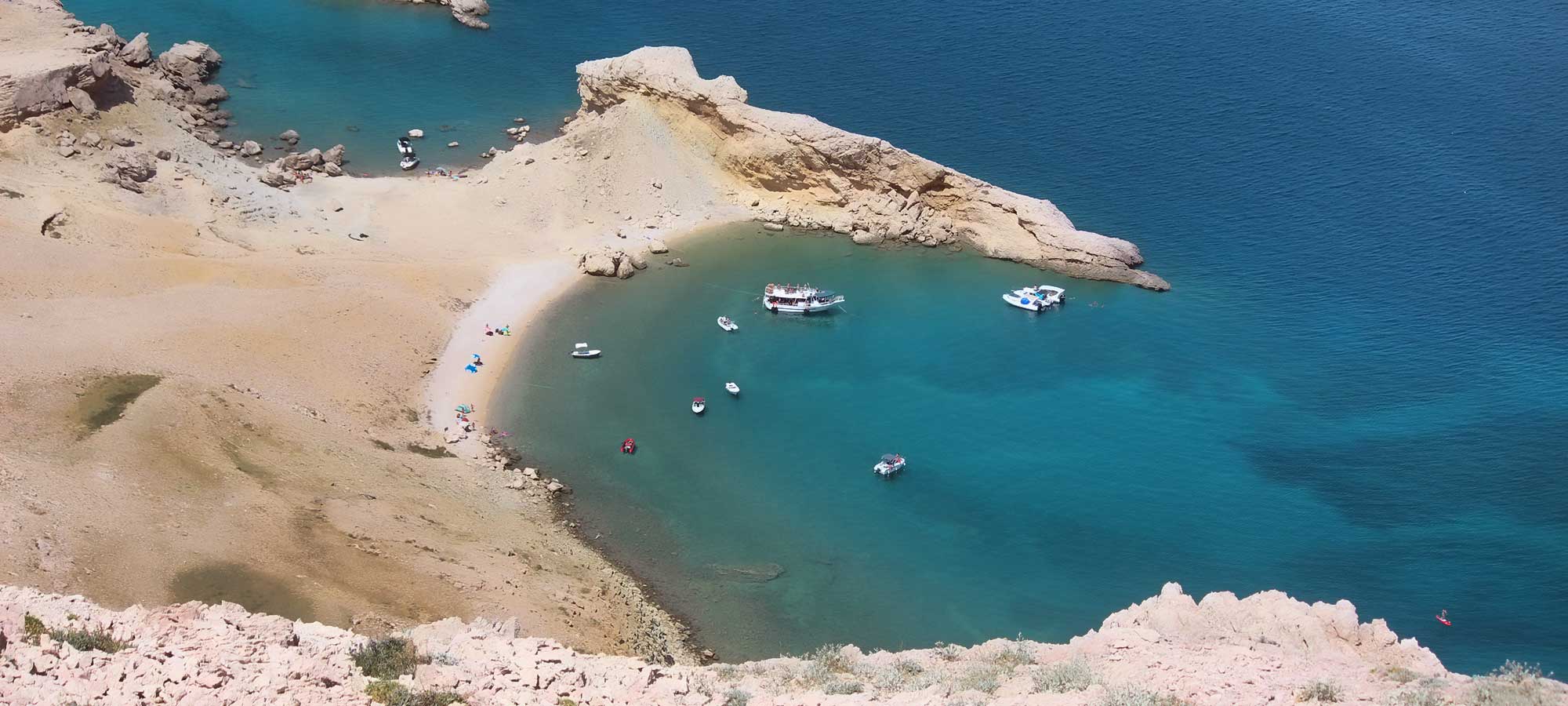
Veli Zaton Beach — The End of the Road, the Beginning of Silence
There are places on the island of Pag that feel like the world has simply run out of people. Veli Zaton Beach is one of them.
Located just 2 kilometres north of Pag town, in the dramatic narrows of the Paška Vrata — the Pag Gate, where Pag Bay meets the Velebit Channel —
this secluded pebble cove offers something that is increasingly difficult to find on the Adriatic: complete, uninterrupted peace.
The scenery here is extraordinary. From the rocky hill separating Veli Zaton from its smaller neighbour Mali Zaton, the entire panorama of the island reveals itself —
Pag Bay stretching to the south, the Šestakovci rocks rising from the sea, Cape St. Christopher with its small stone church and white lighthouse marking the passage,
and the full wall of the Velebit mountain range completing the scene behind it. It is the kind of view that belongs in a painting. The kind that makes the journey —
by boat, or on foot from Pag town — feel entirely justified.
The beach itself is pebble and stone, with a seabed that deepens quickly after entry — perfect for swimmers and free divers who prefer depth and clarity over comfort and
crowds. No natural shade, no facilities, no catering. This is a beach that asks you to come prepared and rewards you with something no resort can offer: the sound of waves,
the cry of seagulls, and a horizon entirely to yourself.
Accessible by boat or on foot, Veli Zaton is one of the finest wild beaches near Pag town — and one of the most quietly spectacular spots
on the entire island.
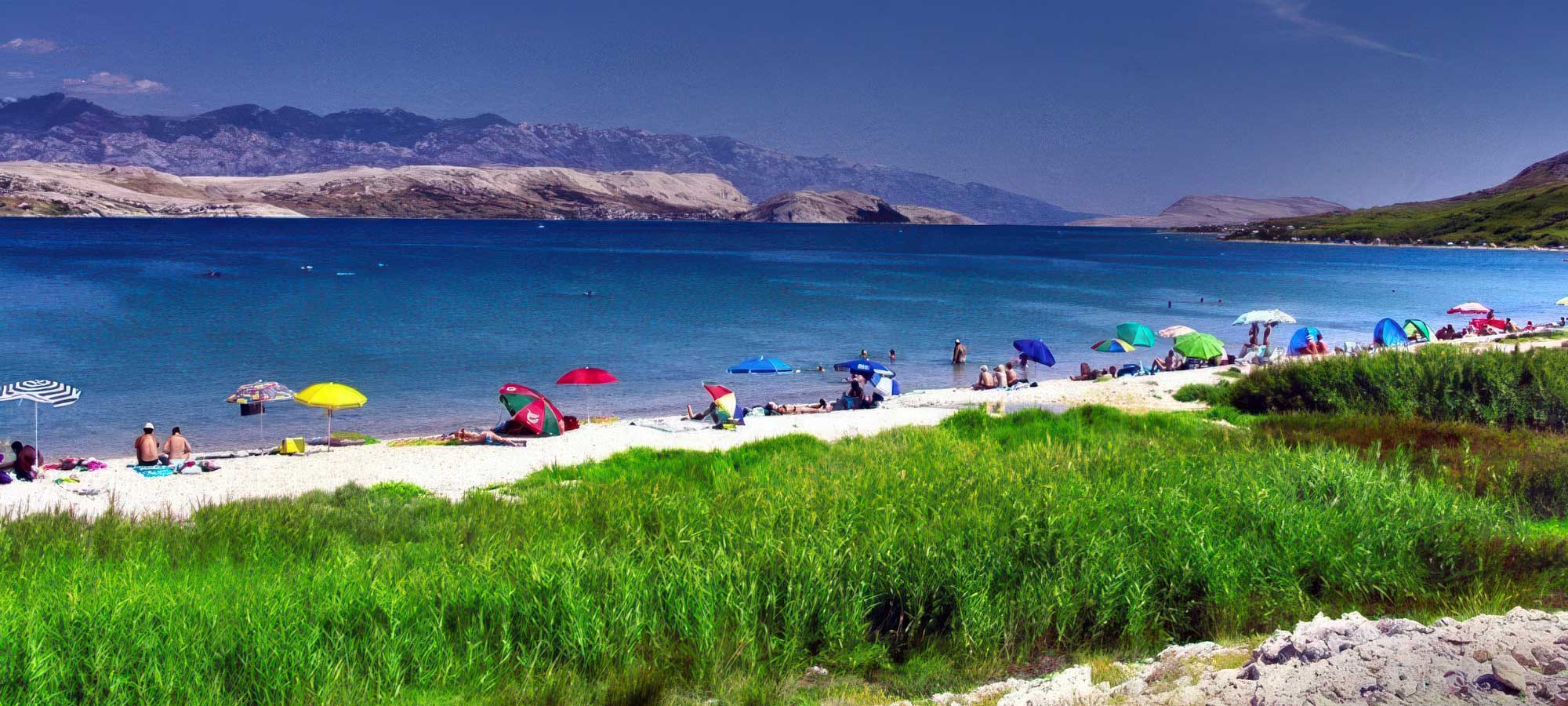
Čista Beach — Clean by Name, Extraordinary by Nature
The name says it all — and then some. Čista, meaning "clean" in Croatian, is a beach that earns its title every single day.
Located between Novalja and Kolan on the western coast of Pag, just 5 kilometres from the famous Zrće beach yet a world away in atmosphere,
Čista is everything that Zrće is not: quiet, unhurried, and genuinely unspoiled.
The 500-metre stretch of fine gravel and sand has a seabed that transitions to soft sand just a few steps from shore, remaining incredibly shallow for up to 20 metres out —
barely 1.5 metres deep even at a distance — making it one of the safest and most comfortable bathing spots on the island for families with children,
for those who prefer shallow water, and for anyone who simply wants to float in crystal-clear Adriatic without a thought in their head.
The water clarity here is exceptional, and the view across Pag Bay toward the lunar landscape of the island creates a backdrop that visitors
consistently describe as breathtaking.
Pet-friendly, family-friendly, and welcoming to all — Čista is that rare beach that manages to be both fully equipped and genuinely relaxed at the same time.
Sunloungers and parasols for rent, a beach bar for cold drinks and coffee, and a restaurant serving local specialties including fresh fish and pizza.
Two large car parks make access effortless, and the beach is long enough that even at the height of summer you can find your own space without a struggle.
Five kilometres from the party. A lifetime away in spirit. Čista Beach is one of the finest family beaches on the Island of Pag —
and one of the most consistently underrated.
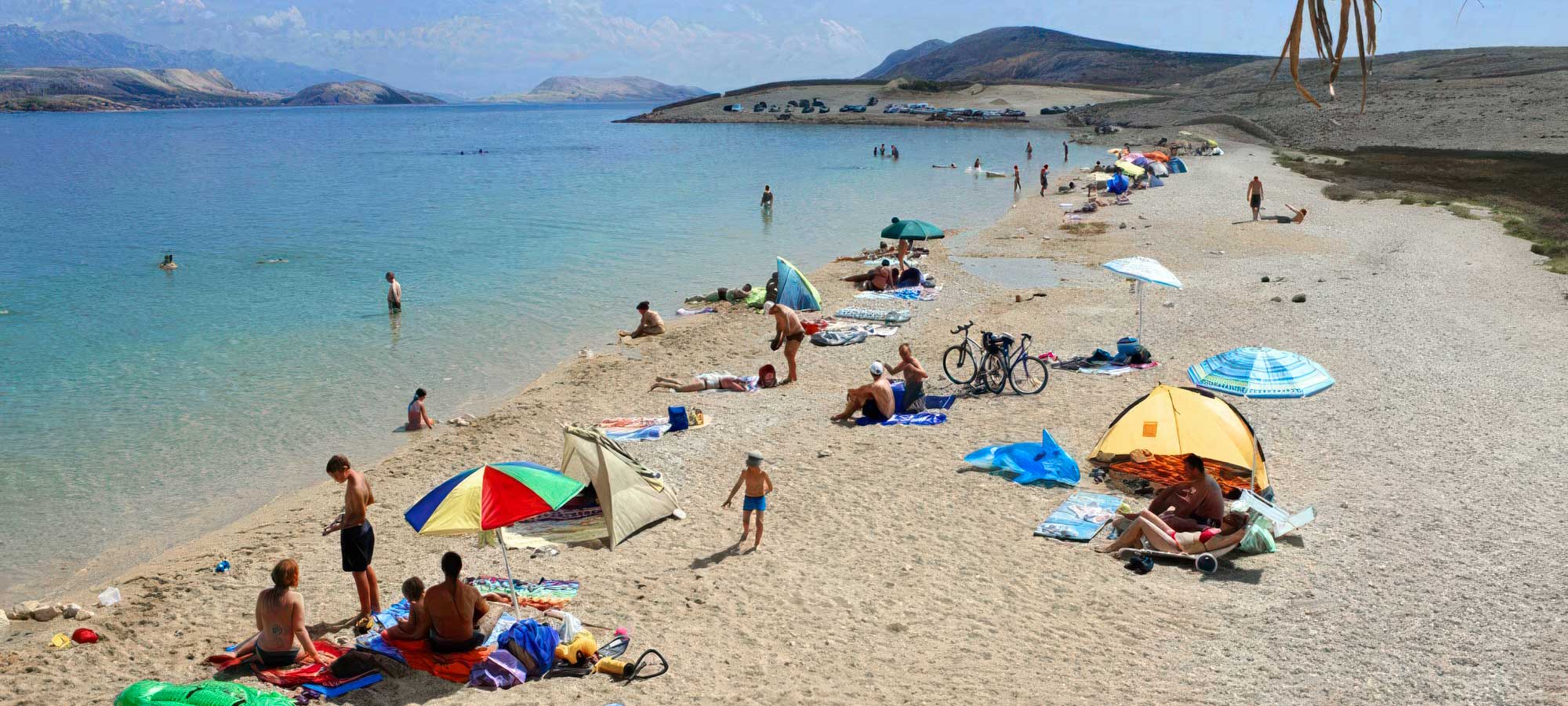
Prnjica Beach — Pag Island's Quietest Hidden Cove
Its name comes from a type of local seashell — and that tells you something about Prnjica Beach straight away.
This is not a beach that announces itself. Located on the western coast of Pag near Kolan, along the road between Novalja and the town of Pag,
it sits quietly between its better-known neighbours Čista and Sveti Duh — and is consistently described by those who find it as the most peaceful and
untouched of the three.
The beach is fine gravel and pebble, with a sandy seabed that becomes accessible just a short distance from shore — gentle enough for families and children,
clear enough to see straight to the bottom. The water here is crystal clean and exceptionally calm, framed by the moonlike rocky landscape of Pag's western coast and
opening out to expansive views across the Adriatic. Scattered shells and unusual rocks along the shoreline make it a favourite for collectors and
photographers looking for something beyond the ordinary.
What makes Prnjica genuinely special is its atmosphere. Even in the height of summer, when neighbouring beaches fill up, Prnjica stays noticeably quieter and more natural.
No beach bars, no sunbed rows, no noise. Just the sound of the sea, the scent of Mediterranean vegetation, and the kind of unhurried calm that is increasingly rare
on the Croatian coast.
Accessible by car with paid parking, wheelchair accessible, and open year-round. Bring your own water, snacks, and sun protection — and water shoes for comfortable entry.
Prnjica Beach is for those who know what they're looking for and are happy to find it without a crowd.
Natural Features of Pag
The Island of Pag is renowned for its unique natural beauty, shaped by a Mediterranean climate, long sunny days, and a deeply indented coastline. Its dramatic landscapes, crystal-clear waters, hidden bays, rocky shores, and scenic viewpoints create a distinctive environment that attracts nature lovers and outdoor enthusiasts throughout the year.
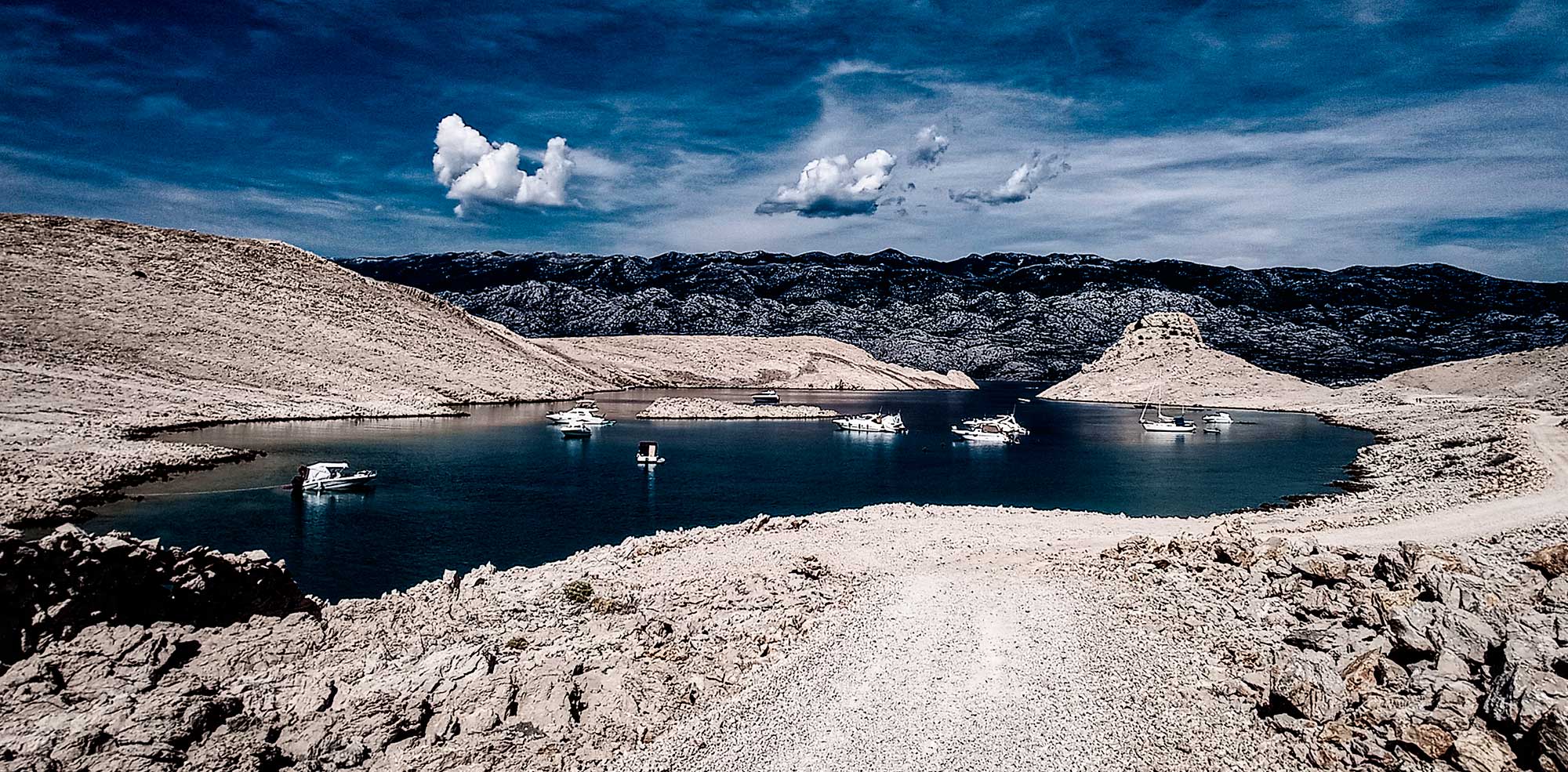
Lunar Landscape — Nature's Own Alien Terrain
Few places in Croatia look quite like the terrain surrounding Metajna. Stripped almost entirely of vegetation and shaped over centuries by the relentless
bura — the powerful north-eastern wind that sweeps down from Velebit — the island's rocky karst has been carved, bleached,
and sculpted into a landscape that feels closer to another planet than the Mediterranean.
This barren beauty is what gave the famous Life on Mars Trail its name: a stretch of coastline where reddish, wind-eroded stone, strange rock formations,
and an almost complete absence of trees create scenery unlike anywhere else on the Adriatic. It's harsh, exposed, and utterly captivating —
proof that a landscape doesn't need greenery to be beautiful.
Further along the coast, this same geological force is responsible for one of the area's most striking natural curiosities:
the Rushmore of the Adriatic, a row of weathered stone peaks whose silhouettes appear almost sculpted by hand.
It's a fitting reminder that on Pag, wind and time have always been the real architects.
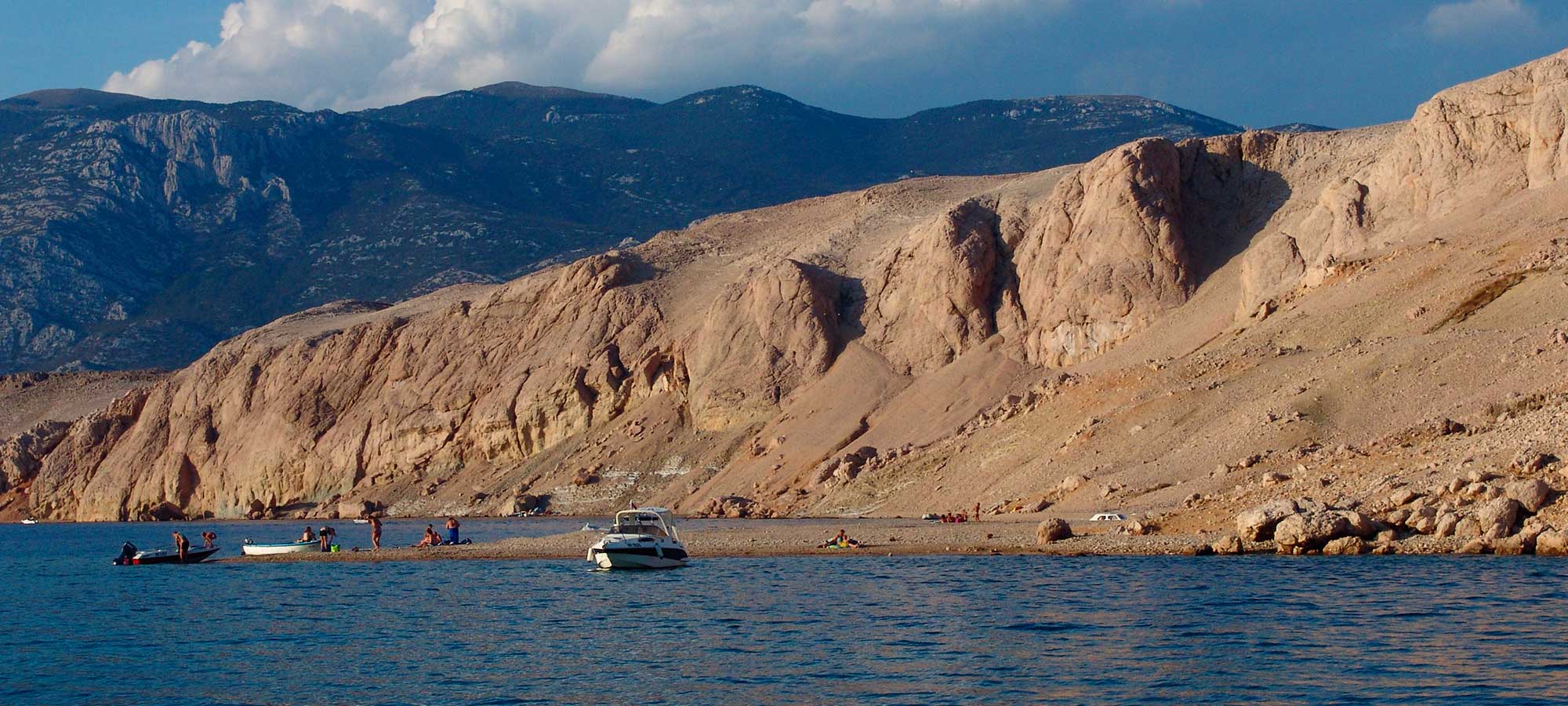
The Rushmore of the Adriatic
Somewhere between the seclusion of Slano cove and the wild edge of Cape Sušac, the coastline of Pag does something no map or guidebook prepares you for:
it turns into faces.
A row of weathered limestone peaks rises directly from the sea, their forms carved by centuries of bura winds, salt spray,
and relentless sun into a sequence of profiles so distinct, so deliberate-looking, that they've earned a nickname among those who've seen them up close —
the Rushmore of the Adriatic. There's no chisel, no sculptor, no monument here in the official sense. Just geology, patience, and the kind of erosion that,
every few hundred thousand years, accidentally produces something that looks like art.
The formation is best appreciated from the water — by boat, kayak, or paddleboard, drifting slowly along this stretch of the Pag Bay coast
where the cliffs meet the Velebit Channel. Seen from the sea in the low light of late afternoon, when shadows deepen and the reddish-gold stone catches the sun at an angle,
the resemblance becomes impossible to unsee: a line of stone heads standing sentinel over the water, facing out toward Velebit as if keeping watch over the channel.
This section of coastline sits along the same wild, otherworldly terrain that gives the nearby Life on Mars Trail its name —
a landscape of red-tinted karst, sculptural rock formations, and complete exposure to the elements. Coming from Slano cove and heading toward Cape Sušac,
this ridge marks one of the most photogenic and least-documented stretches of the entire route.
Bring a camera, bring patience, and if you can, bring a boat. This corner of Pag doesn't advertise itself — it waits to be noticed.
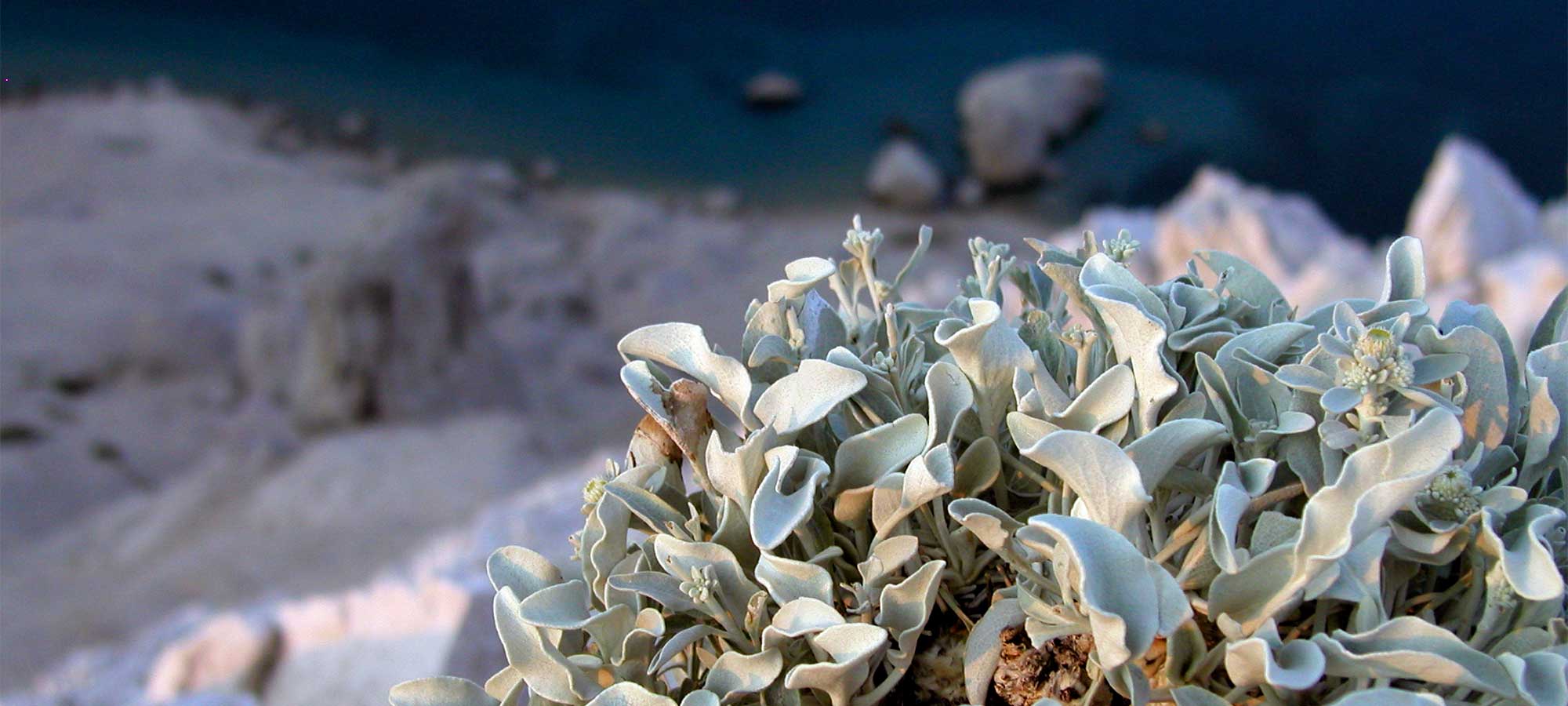
Fields of Sage — Where the Air Smells Like the Island
Across the exposed, rocky terrain around Metajna, a whole community of aromatic plants thrives where almost nothing else can — wild sage among them,
alongside immortelle, wormwood, wild fennel, and wild onion. Hardy and perfectly adapted to Pag's salt-sprayed winds and thin soil,
these plants spread across large stretches of the island in silvery-green patches that soften the otherwise stark, rocky landscape.
Walk any of the trails here in spring or early summer and the fragrance is unmistakable — sharp, herbal, and unmistakably Mediterranean,
carried on the breeze long before you see the plants themselves. This is far from just scenery: the island's sheep graze on this same wild vegetation,
and it's exactly what gives their milk — and in turn, the world-renowned Pag cheese — its distinctive, herb-scented flavour found nowhere else.
More than a fragrant backdrop, these aromatic fields are a small but telling sign of how life persists here —
thriving in conditions where the bura wind and dry summers leave little else standing.
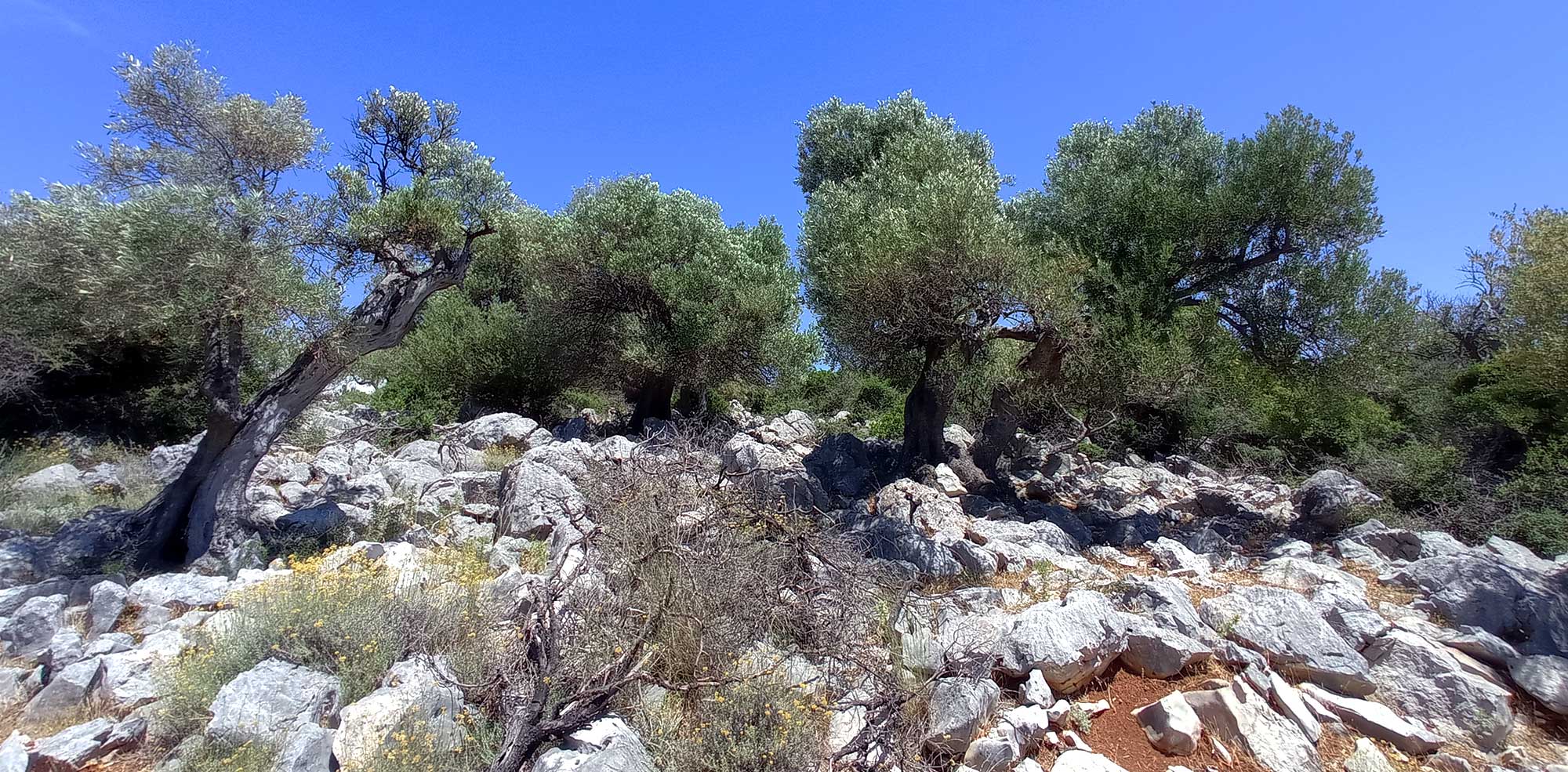
Ancient Olive Groves — Trees That Have Outlived Empires
The island of Pag is home to centuries-old olive trees that produce some of Croatia's most exquisite extra-virgin olive oil,
prized far beyond the island itself. But nowhere is this ancient legacy more astonishing than in the Lunjski maslinici —
the olive groves near the village of Lun, at the island's northern tip.
Here, among roughly 80,000 olive trees spread across the landscape, grow some of the oldest wild olive trees on Earth —
gnarled, wind-twisted giants whose age has been scientifically estimated at over 1,500 years, with the very oldest believed to be around 2,000 years old.
Recognised for their extraordinary botanical value, part of the Lunjski maslinici has been a protected nature reserve since 1963,
and a marked walking trail now winds through the grove, letting visitors walk among trees that were already ancient when much of European history was still being written.
The oil pressed from these groves — including from wild olives growing here since long before human cultivation — is considered exceptional, shaped by the same salt,
wind, and stone that define everything else on this island. Standing among these trees, twisted into shapes no human hand could design,
is one of the most humbling experiences Pag has to offer.
Attractions & Sights
The Pag Triangle — Croatia's Greatest Unsolved Mystery
On an island that already looks like another planet, there is one spot that takes the sense of the otherworldly to another level entirely.
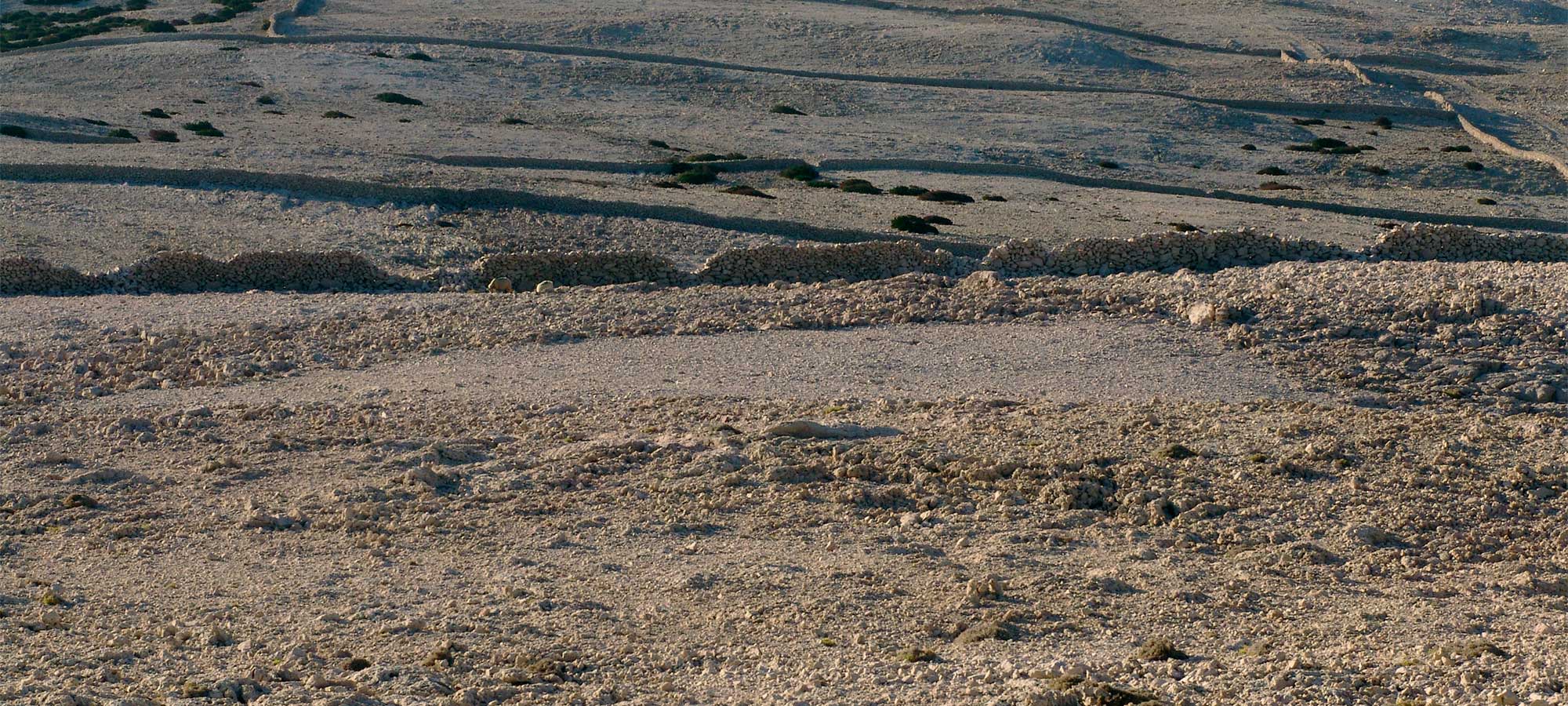
The Pag Triangle — or Paški Trokut — is a precise geometric formation pressed into the bare limestone rock near Metajna and
the ruins of ancient Caska. An isosceles triangle with a surface area of 500 square metres, clearly distinguishable in colour and
texture from the surrounding terrain, and perfectly visible from the air. It lay hidden from human eyes for centuries,
buried in one of the most inaccessible and untrodden corners of the island.
It was discovered entirely by accident in May 1999, when surveyor Zdenko Grbavac noticed something unusual in the rock while taking geodetic measurements.
What followed was a wave of scientific, journalistic, and public interest that has never entirely subsided. Geologists, palaeontologists, archaeologists, and
UFOlogists have all visited the site. None have produced a convincing explanation for its origins.
What is known is this: the rocks inside the triangle are round and cylindrical — shaped, not random. When exposed to ultraviolet light, they emit red phosphorescence,
a sign of extreme heat treatment, by some estimates carried out over 12,000 years ago. Similar properties have not been found in any rock in the surrounding area.
The triangle has been officially designated a natural landmark by the town of Novalja. In the years since its discovery, it is estimated that over half a million people
have visited the site.
Is it an ancient ritual site? A landing mark left by something not of this world? A geological anomaly that science has yet to explain? Nobody knows —
and that, perhaps, is exactly the point. On an island where the landscape already feels like the surface of Mars,
the Pag Triangle is the one feature that makes you wonder whether that comparison might be more than poetic.
Accessible via a marked path from the main road near Metajna — follow the signs, open the gate, and walk in.
Town of Pag — A Medieval Masterpiece in Stone
Most Croatian coastal towns grew organically over centuries, shaped by necessity and chance. The Town of Pag is different.
Built in 1443 to a precise urban plan developed in Venice, it is one of the rare examples of a fully planned medieval town in Croatia — its central square,
four main streets, and four distinct districts laid out with geometric intention that is still clearly visible today. The architect behind that vision was
Juraj Dalmatinac, the same master builder and sculptor responsible for the Cathedral of Šibenik, one of the finest Renaissance buildings
in the world.
Walking through Pag town today is walking through a living monument. The narrow stone streets, the intact medieval core, the partial 15th-century walls and
the Skrivanat Tower — the only one of the original nine defensive towers still standing — all speak to a town that has preserved its character
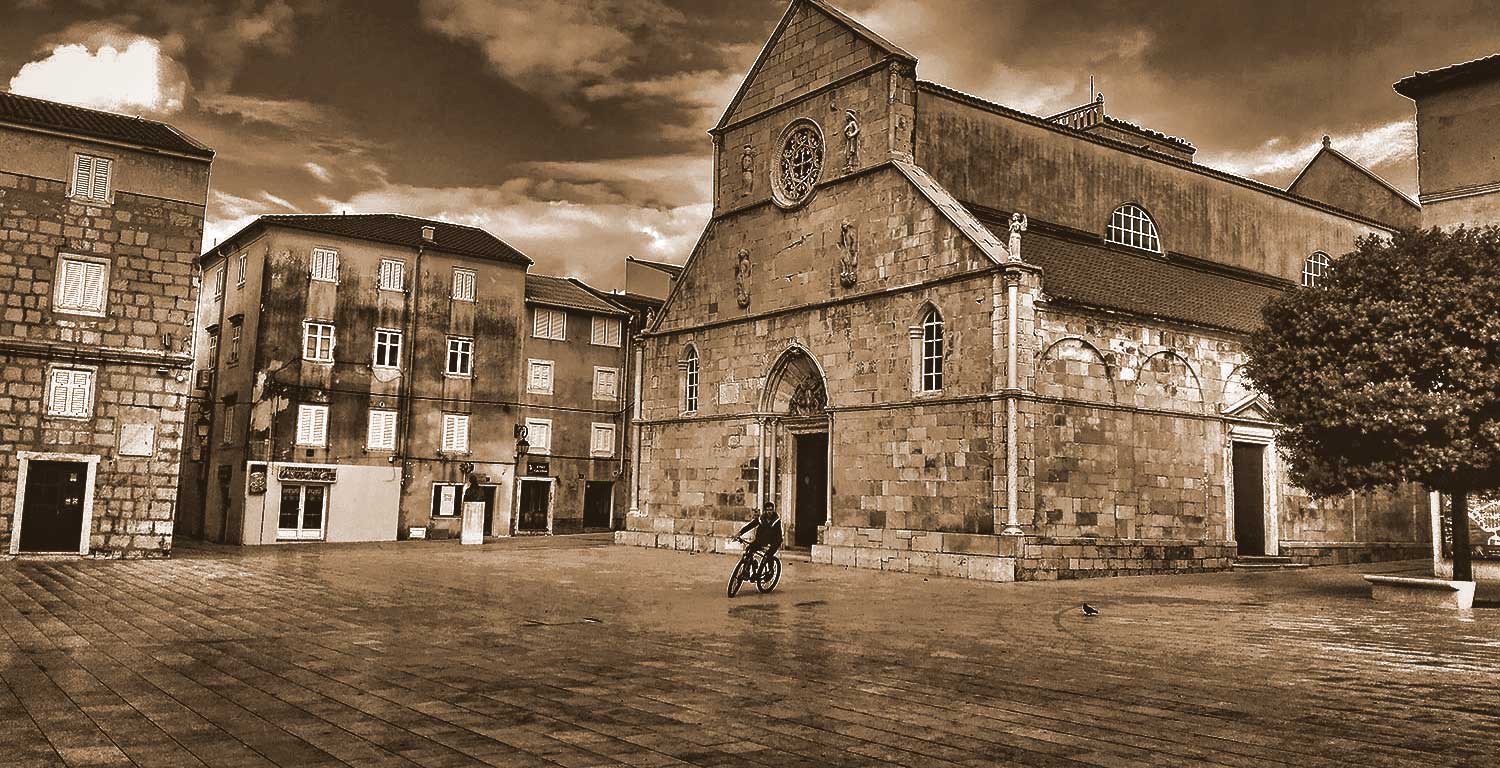
with remarkable care. At the heart of it all is Trg Kralja Krešimira IV, the main square, where two of Dalmatinac's original buildings
still stand face to face: the Duke's Palace (Knežev dvor), where the princes of Pag once ruled and which today serves as a café,
and the Parish Church of the Assumption of Mary — a Gothic-Renaissance basilica begun in the 15th century, completed in the 16th,
and restored in the 18th, containing valuable works of art including a Gothic wooden cross and a precious silver processional cross.
The Benedictine Monastery of St. Margarita is one of the most remarkable institutions on the island. Founded immediately after the new town was established,
it has been a centre of spiritual life, education, and craftsmanship for over five centuries. Since the 16th century, the Benedictine sisters have taught
lacemaking to generations of girls — making the monastery the cradle of Pag lace, a tradition so refined and so unique that it has been
inscribed on the UNESCO Intangible Cultural Heritage list. The monastery holds a permanent exhibition of sacral art, including relics, paintings, sculptures,
and examples of lace that have been valued by emperors and admired by the world. A Reliquary of the Holy Thorn — a fragment of the Crown of Thorns,
brought from the Holy Land in 1433 — is among its most treasured possessions.
The town of Pag is also the birthplace of Bartol Kašić (1575–1650), a Jesuit priest and scholar who wrote the first Croatian grammar —
a landmark achievement that earned him the title of the Father of the Croatian Language. Born in Pag, Kašić went on to become one of the most significant figures
in the history of Croatian literature and linguistics, and his legacy remains a source of quiet pride for a town that has been shaping Croatian culture since
the 15th century.
Just a short walk from the new town, the ruins of Old Pag — the original settlement abandoned in the 15th century — include the remains of
a Franciscan monastery and the Church of St. Mary, which stands on the site of a Croatian basilica from the 8th century and houses a precious
14th-century wooden statue of the Virgin Mary. Every year on August 15th, the statue is carried in a solemn procession back to its original home —
a tradition rooted in a legend of miraculous protection during a 19th-century cholera epidemic that has been faithfully observed ever since.
The town of Pag is also the home of the island's famous salt pans — Solana Pag, the largest salt harvesting site in Croatia,
producing quality salt using methods unchanged for over a thousand years.

Ruins of Fortica Fortress & Pag Bridge — Where History Meets the Modern World
At the southern tip of the island, where the narrow strait separates Pag from the Croatian mainland, two structures stand side by side across six centuries
of history — one a crumbling reminder of a more dangerous past, the other a feat of 20th-century engineering that changed the island forever.
The Fortica Fortress was built at the beginning of the 17th century with a single, clear purpose: to control the passage between the island of Pag and
the mainland, and to protect merchant ships navigating what was then one of the busiest and most pirate-prone sea routes on the Adriatic. Perched on a rocky promontory
directly above the strait, the fortress commanded an unobstructed view of every vessel passing through the channel — and its cannons ensured that not much passed
without permission. The site may be even older than its 17th-century construction date suggests. Legend holds that it was here that the Hungarian King Béla IV briefly
took refuge while fleeing the Mongol invasion of 1241, welcomed by the people of Pag in one of the island's most dramatic historical moments.
Today the fortress stands in atmospheric ruin — walls of bare stone against a bare karst hillside, surrounded by the moonlike landscape that defines this corner of
the island. No facilities, no entrance fee, no crowds. Just the wind, the ruins, and a view across the strait that has barely changed in four centuries. Accessible
via a road to the left immediately after crossing the bridge from the mainland.
Standing directly beside it, the Pag Bridge represents an entirely different chapter of the island's story. Completed on 17 November 1968,
this 301-metre concrete arch bridge spans 35 metres above the sea and connects Pag permanently to the Croatian mainland — ending centuries of isolation and
transforming the island's economy and identity almost overnight. Before the bridge, a ferry connection operated from below the Fortica.
During the Croatian Homeland War in the early 1990s, the bridge was the only road link between Dalmatia and the rest of the country —
a fact that gave it a strategic significance its builders could not have anticipated. Crossing it today, with the Fortica ruins below and the open Adriatic on one side,
remains one of the most quietly dramatic arrivals in Croatia.
Pag Lace Gallery — The Art That Emperors Collected and UNESCO Protects
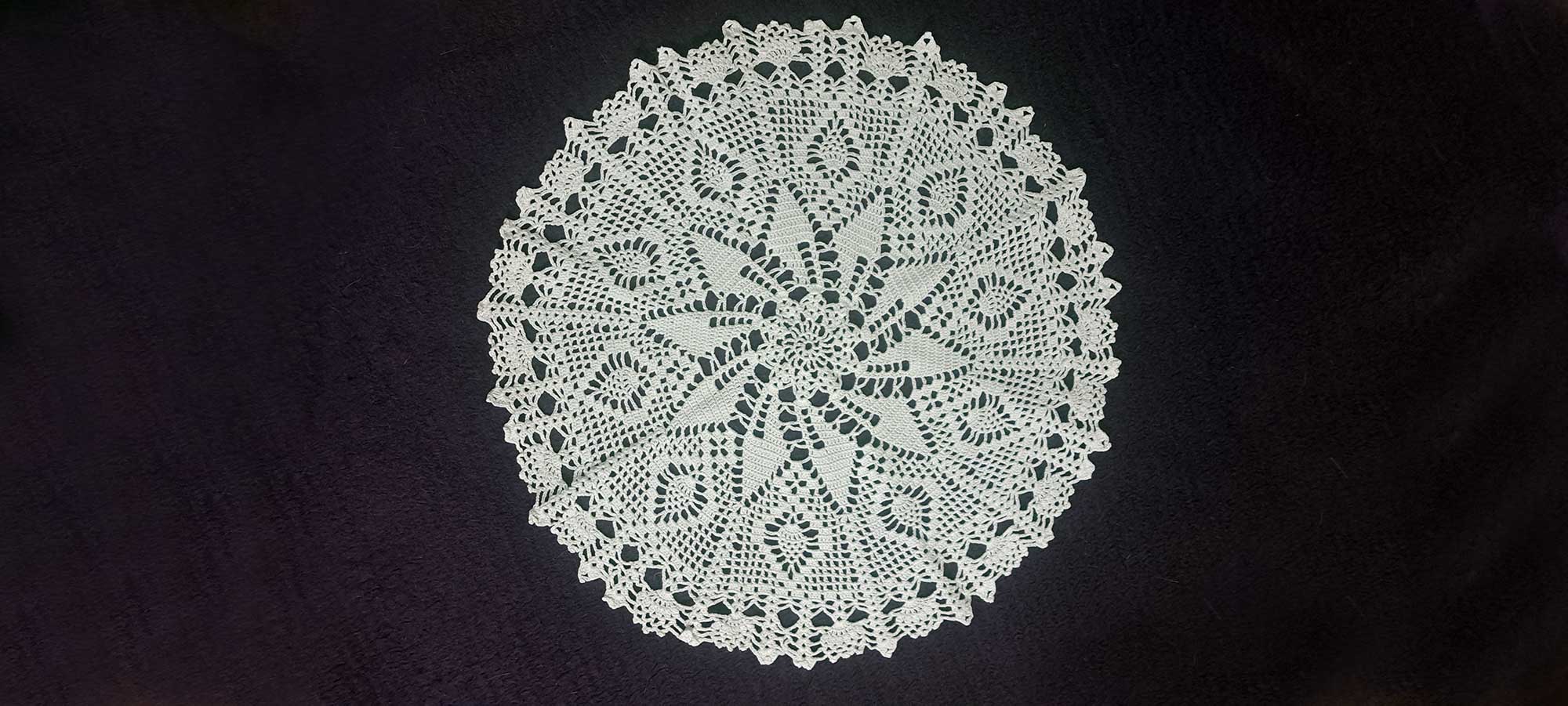
There are crafts, and then there is Pag lace. Made with a needle, thread, and a firm pillow as backing — no drawings, no stencils,
no templates — this is an art form transmitted entirely from hand to hand, from mother to daughter, from generation to generation, for over five centuries.
Each piece is unique. Each carries within it the accumulated knowledge and personal touch of every woman who made lace before her.
The Croatian Ministry of Culture has declared the collection held by the Benedictine nuns of Pag a national heritage.
UNESCO inscribed it on the Representative List of the Intangible Cultural Heritage of Humanity in 2009.
The origins of Pag lace are believed to trace back to ancient Mycenae — making it not just a Croatian tradition but one of the oldest surviving lacemaking traditions
in the Mediterranean world. Its documented history on Pag begins in the late 15th century, when the Benedictine sisters of the Monastery of St. Margarita first
began teaching the craft to the women of the town. From ecclesiastical vestments and altar cloths it spread to tablecloths, bedspreads, garments,
and eventually into homes across the island as a stand-alone art form displayed on walls and framed like the paintings they resemble.
The reach of Pag lace extended far beyond the island. Empress Maria Theresa kept a Pag lacemaker at the imperial court in Vienna, sewing lace exclusively for
the royal household. In 1911, an Austrian writer presented a Pag lace blouse to Archduchess Maria Josephine — who then travelled to Pag to place her own order,
followed by other ladies of the nobility. At the World Exhibition in Paris in 1937, Pag lace received a gold plaque for exceptional handcraft. Between 1906 and 1943,
it was exhibited in London, New York, Budapest, Vienna, Milan, and Prague.
The Pag Lace Gallery, opened in 1998 in the Duke's Palace on Petar Krešimir IV Square in the heart of Pag town, preserves and displays this
extraordinary tradition. Visitors can watch local women at work — the same needle, the same thread, the same geometric patterns radiating from a central circle
outward through an intricate web of triangles — and browse a collection spanning multiple centuries of lacemaking. Smaller pieces are available to purchase
in shops around town, and the Benedictine nuns of St. Margarita continue to teach the craft to new generations.
On summer evenings in Pag town, it is still possible to see women sitting in doorways and on benches, bent over their pillows, making lace in the open air.
In a world of mass production and digital everything, the sight is quietly astonishing.
Concerts — The Sound of the Adriatic, Live Under the Stars
Klapa — the word means "a group of friends" in the Dalmatian dialect — is a form of traditional a cappella singing rooted in the coastal communities
of Dalmatia, inscribed on the UNESCO Representative List of the Intangible Cultural Heritage of Humanity in 2012. Voices, harmony, and songs of love,
the sea, and homeland — nothing else required.
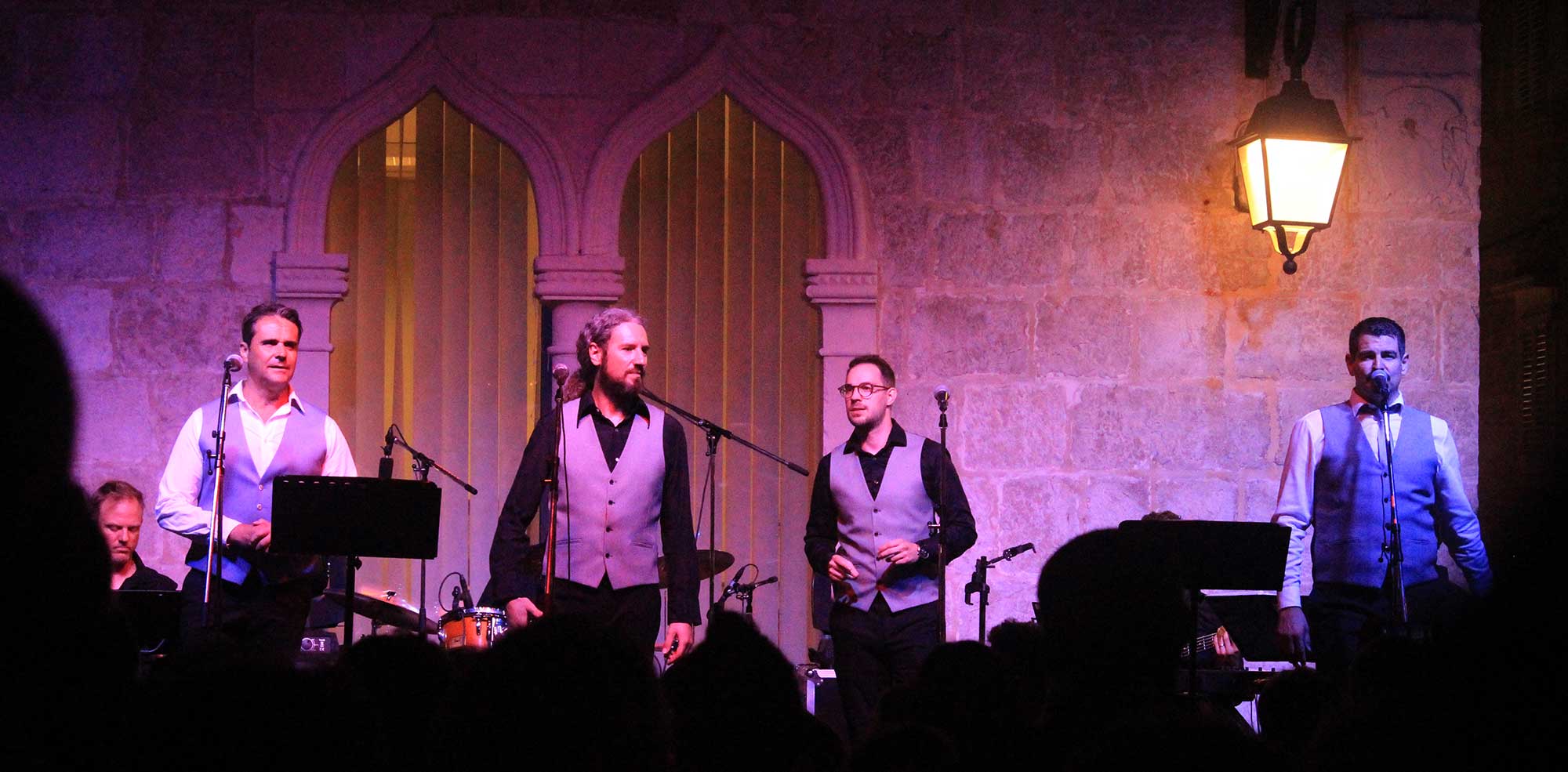
The island's own Klapa Sol, founded in 1996, is one of the most decorated klapa ensembles in Croatia — winners of the City of Pag Annual Award,
the Zadar County Award, and multiple prizes at the most prestigious festivals in the country, including first place at the Split Festival and
the Festival of Melodies of Istria and Kvarner. Their performances are a fixture of the Pag Cultural Summer, held in the Cathedral, the Duke's Palace atrium,
and on the town's stone streets under the open sky.
But heritage concerts are only one side of Pag's musical life. Throughout the season, the island hosts countless live music events —
from intimate evenings in local konobas to party cruises aboard excursion boats that make daily circular tours of Pag Bay, sailing from Pag town to Slana, Metajna,
and Zrće before returning to port. And at the northern end of the island, Zrće Beach has become one of Europe's most iconic open-air music destinations,
attracting the world's most renowned DJ names to its legendary clubs season after season.
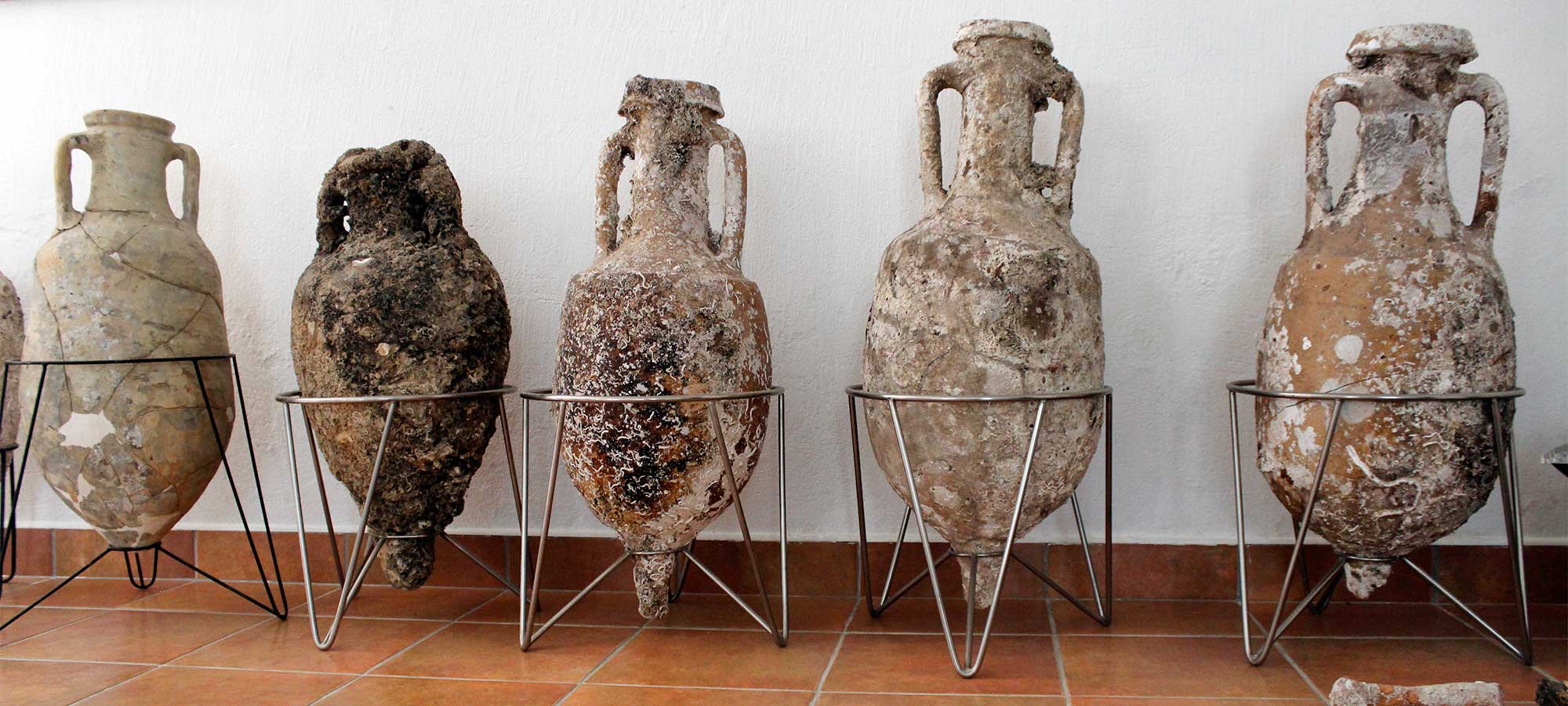
Museum — Two Thousand Years Beneath the Streets of Novalja
The City Museum of Novalja is one of those places that surprises visitors who expect a standard regional collection and
instead find themselves standing in a 2,000-year-old Roman tunnel carved entirely by hand from solid rock.
The museum's collection spans the full arc of the island's history — prehistoric stone tools and pottery, Roman coins and artefacts, traditional costumes and textiles,
exhibits on the island's salt-making and fishing industries, and rotating exhibitions of Croatian art. But the centrepiece, and the reason most visitors make the journey,
lies beneath the building: the Talijanova Buža — the Italian Hole — an ancient underground aqueduct built in the 1st century AD
during the reign of Emperor Augustus to supply the Roman settlement of Novalja with fresh water from the surrounding fields.
Stretching 1,042 metres through solid limestone, averaging just 60 centimetres in width, the aqueduct is the only underground Roman aqueduct on the entire
Croatian Adriatic coast — and one of the most remarkable pieces of ancient engineering in the region. Visitors can enter directly from the museum and walk
a 150-metre section of the tunnel, hard hat and flashlight provided, through a passage that has barely changed in two thousand years. Historians, archaeologists,
and curious travellers consistently describe it as one of the most unexpectedly extraordinary experiences on the island.
The museum also serves as the gateway to the wider archaeological story of the area — including the sunken Roman city of Cissa,
destroyed by earthquake in 361 AD and now resting on the seabed of Pag Bay near Caska, and the wreck of a 1st-century Roman merchant ship carrying amphorae,
discovered in the Velebit Channel and accessible to divers.
For anyone with even a passing interest in history, the City Museum of Novalja is a must — and a perfect choice for a rainy afternoon that turns
into something you'll be talking about for years.